


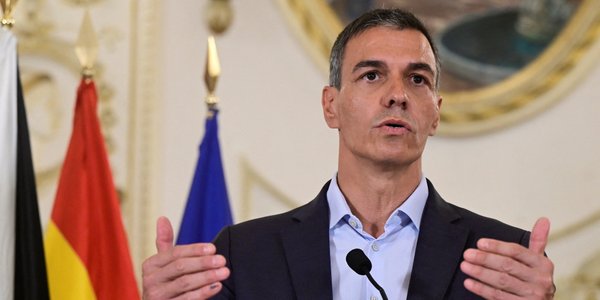
Spain's PM counters Schengen suspension calls with border data
Translated from Polish, summarized and contextualized by DistantNews.
At a glance
News
Sources not specified
Context piece
- Several European countries, including Italy, Denmark, Finland, Sweden, and Norway, have called for Spain to be suspended from the Schengen area due to the migrant crisis.
- Spanish Prime Minister Pedro Sánchez responded by presenting Frontex data showing lower illegal border crossings via Spain compared to other EU routes.
- Sánchez urged for EU unity, stating that solidarity and empathy are optional, but adherence to treaties and data is not.
Spanish Prime Minister Pedro Sánchez has forcefully pushed back against calls from several European nations to suspend Spain from the Schengen zone amid the ongoing migrant crisis. Italy, Denmark, Finland, Sweden, and Norway have reportedly expressed a desire to see Spain excluded from the open-border area.
In response, Sánchez took to social media platform X to present data from the European Border and Coast Guard Agency (Frontex). He highlighted statistics for illegal border crossings into the EU between 2021 and 2026, arguing that routes through Italy, the Western Balkans, and Greece have seen significantly higher numbers than the Spanish route.
"Solidarity and empathy are optional. Respect for European treaties and data – no," Sánchez declared, framing his argument around the factual evidence. He emphasized that while cooperation and compassion might be choices, adherence to established agreements and verifiable data is a non-negotiable requirement within the EU framework.
Solidarity and empathy are optional. Respect for European treaties and data – no.
According to the Frontex figures Sánchez shared, the route via Italy recorded the highest number of illegal crossings at 478,600 during the period. The Western Balkans route followed with 340,600, and Greece with 259,800. Spain's route registered 234,760 crossings, while the EU's eastern border saw a considerably lower figure of 48,000.
Sánchez concluded his statement with an appeal for unity within the European Union. "This is not the time for divisions. It is time to continue building a strong and united European Union," he urged, positioning his defense against the backdrop of international criticism as a call for collective action and solidarity based on shared data and commitments.
This is not the time for divisions. It is time to continue building a strong and united European Union.
DistantNews Editorial
Originally published by Rzeczpospolita in Polish. Translated, summarized, and contextualized by our editorial team with added local perspective. Read our editorial standards.
More Stories

From Our Blog

What Gets Lost (and Found) When News Is Translated

The Critical Role of Diaspora Media in Global News

What Travellers Should Know About Countries with Restricted Press

A Digital Nomad's Guide to Following Local News

How the Same Story Looks Different in Different Countries
