

/nginx/o/2026/07/24/17803167t1h1da2.jpg)
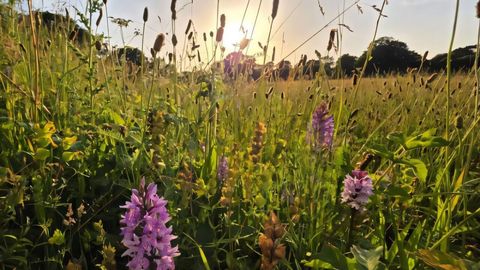
Study: Farmland Can Become Rich Meadow Naturally With Just Annual Mowing
Translated from Estonian, summarized and contextualized by DistantNews.
At a glance
News
Sources not specified
Context piece
- A long-term study in England shows that former farmland can become a species-rich meadow without sowing seeds, requiring only natural regeneration and annual mowing.
- Over a decade, many rare plants and orchids returned to the area.
- Researchers suggest that patience, rather than expensive seed mixes, is key for large-scale ecological restoration.
Former agricultural land can transform into a biodiverse meadow simply through natural regeneration and annual mowing, according to a long-term study conducted in England. The research indicates that expensive seed mixes and intensive soil preparation may not be necessary for ecological restoration projects.
On a small field in Norfolk, nature was allowed to take its course after the last rapeseed harvest. The land was left as a meadow without the introduction of new seed mixtures, deep plowing, or soil cultivation. The only human intervention was an annual hay cut. This approach allowed the ecosystem to recover on its own.
Over a ten-year period, the study observed the return of numerous rare plants and orchids to the area. This natural process demonstrated that a meadow could become rich in species without human-aided seeding. The findings challenge conventional conservation tactics that often rely on costly seeding strategies.
Scientists involved in the study suggest that patience is a crucial factor when undertaking large-scale restoration efforts. Allowing natural processes to unfold, coupled with minimal intervention like annual mowing, can lead to significant biodiversity gains. This method proves that nature's own recovery mechanisms, given time and space, can be highly effective in re-establishing diverse plant life.
DistantNews Editorial
Originally published by Postimees in Estonian. Translated, summarized, and contextualized by our editorial team with added local perspective. Read our editorial standards.
More Stories
/nginx/o/2026/07/23/17801324t1h5e6f.jpg)
/nginx/o/2026/05/20/17651481t1hae55.jpg)
/nginx/o/2026/07/19/17793483t1he5b5.jpg)
From Our Blog

What Gets Lost (and Found) When News Is Translated

The Critical Role of Diaspora Media in Global News

What Travellers Should Know About Countries with Restricted Press

A Digital Nomad's Guide to Following Local News

How the Same Story Looks Different in Different Countries
