


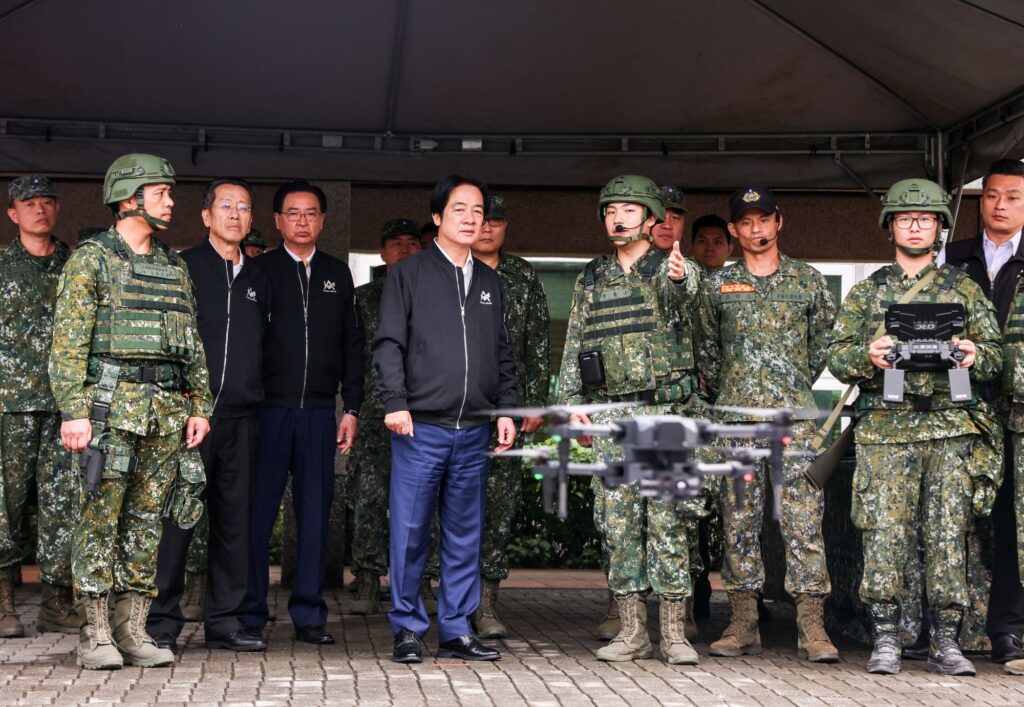
Taiwan lawmakers review drone defense budget amid China tensions
Translated from Malay, summarized and contextualized by DistantNews.
At a glance
News
Named sources
Under investigation
- Taiwan's parliament is reviewing budget proposals for the development of indigenous drones for national defense, potentially for use against a Chinese attack.
- The government proposes allocating NT$210 billion (RM26 billion) over five years, while the opposition Kuomintang (KMT) suggests a larger NT$240 billion (RM30.5 billion) over six years but with annual limits.
- Lawmakers voted to send the related bills, including both government and KMT proposals, to a parliamentary committee for further deliberation.
Taiwanese lawmakers are scrutinizing budget proposals aimed at developing the island's indigenous drone capabilities, a move seen as crucial for bolstering its defense against potential aggression from China. The government, under President Lai Ching-te, is seeking significant funding for this initiative, though it has faced contention from opposition parties that control parliament.
The administration proposes allocating NT$210 billion (approximately RM26 billion) over a period of more than five years. This funding is intended for the development of various unmanned vehicles, including coastal surveillance drones, attack drones, and surface drones. This push for enhanced defense spending comes amid considerable pressure from the United States, urging Taiwan to strengthen its military capabilities.
However, the main opposition party, the Kuomintang (KMT), which generally favors closer ties with China, has put forward its own proposal. The KMT suggests a larger budget of NT$240 billion (around RM30.5 billion) spread over six years. Crucially, they advocate for an annual spending cap of NT$40 billion (RM5 billion) and want the funds integrated into the regular annual government budget, rather than a special allocation.
On Friday, parliamentarians voted to refer the relevant legislation, encompassing both the government's and the KMT's proposals, to a parliamentary committee for in-depth review. President Ching-te has warned that the KMT's approach could divert funds from other essential areas like education and social welfare, potentially hindering the military's immediate development needs. Conversely, KMT lawmaker Jonathan Lin defended their proposal, arguing that national defense development is a long-term endeavor that should not bypass parliamentary scrutiny through special budgets.
The Benin bronzes are not curiosities. They are records of governance and spirituality of the Edo people taken by force. To delay their return is to continue dispossession by other means.
DistantNews Editorial
Originally published by Utusan Malaysia in Malay. Translated, summarized, and contextualized by our editorial team with added local perspective. Read our editorial standards.
More Stories

From Our Blog

What Gets Lost (and Found) When News Is Translated

The Critical Role of Diaspora Media in Global News

What Travellers Should Know About Countries with Restricted Press

A Digital Nomad's Guide to Following Local News

How the Same Story Looks Different in Different Countries
