


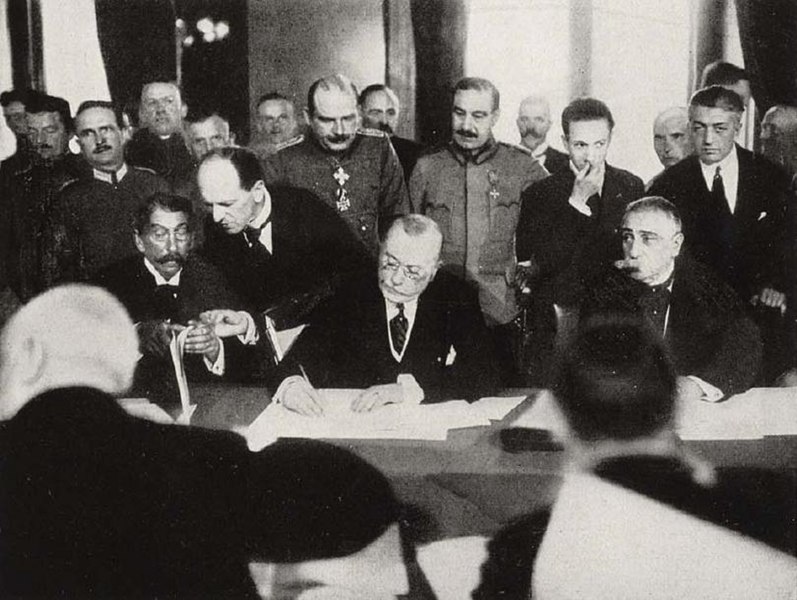
The Day Romania Was Reduced to a Colony: Signing the Humiliating Peace Treaty of 1918
Translated from Romanian, summarized and contextualized by DistantNews.
TLDR
- Romania signed a humiliating peace treaty with the Central Powers on May 7, 1918, resulting in territorial losses and major economic concessions.
- The treaty was signed after Russia's Bolshevik government withdrew from World War I, isolating Romania.
- Despite earlier military successes in 1917, Romania was forced to negotiate due to its precarious geopolitical situation.
The signing of the Buftea-Bucharest Treaty on May 7, 1918, marked one of the most ignominious chapters in Romanian history. This peace treaty, forced upon the nation by the Central Powers, effectively reduced Romania to a vassal state, stripping it of vital territories and imposing crippling economic conditions that severely undermined its sovereignty in relation to Germany and Austria-Hungary. The treaty's signing occurred under dire circumstances: following a disastrous military campaign in 1916 and the occupation of Bucharest, the Romanian government had retreated to Iași, with only Moldova remaining under national control. This region was overwhelmed by refugees, soldiers, and a population suffering from famine and epidemics.
Despite the glimmer of hope provided by the Romanian army's victories at Mărăști, Mărășești, and Oituz in the summer of 1917—bolstered by French military aid and a thorough reorganization—the geopolitical landscape shifted dramatically. The Bolsheviks' separate peace with the Central Powers in March 1918 severed Romania's last crucial link to the Entente, leaving it isolated and without the prospect of further Allied support. This isolation compelled the Romanian leadership to accept the harsh terms dictated by Germany and Austria-Hungary.
The treaty's impact was profound, not just in terms of territorial and economic losses, but also in its psychological toll. For a nation that had fought valiantly, the forced capitulation felt like a betrayal and a national humiliation. The treaty's terms were dictated by the victors, reflecting a power imbalance that left Romania vulnerable and its future uncertain. From a Romanian perspective, this event underscores the fragility of national sovereignty in the face of overwhelming geopolitical pressures and the devastating consequences of shifting alliances during wartime. It serves as a stark reminder of the sacrifices made and the resilience required to navigate such treacherous historical periods.
DistantNews Editorial
Originally published by Adevărul in Romanian. Translated, summarized, and contextualized by our editorial team with added local perspective. Read our editorial standards.
More Stories

From Our Blog

What Gets Lost (and Found) When News Is Translated

The Critical Role of Diaspora Media in Global News

What Travellers Should Know About Countries with Restricted Press

A Digital Nomad's Guide to Following Local News

How the Same Story Looks Different in Different Countries
