


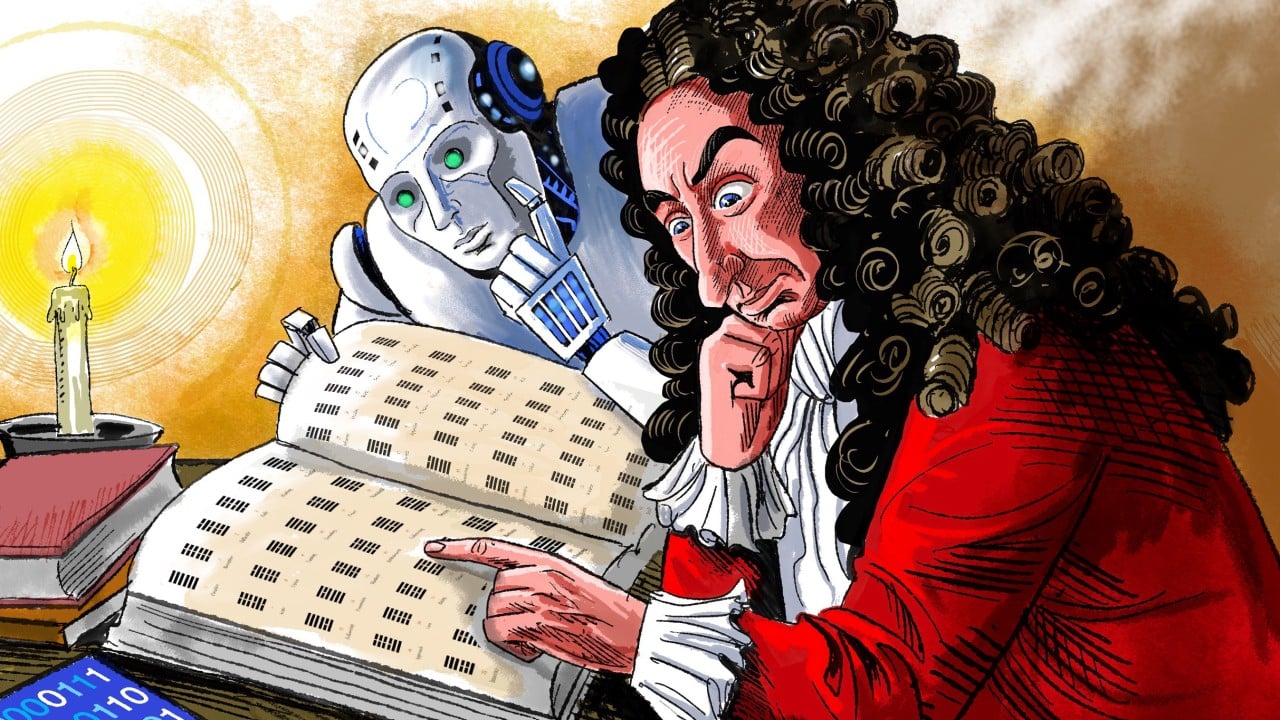
The I Ching, Leibniz, and AI: How ancient China-West links shaped modern science
Translated from English, summarized and contextualized by DistantNews.
At a glance
In-depth
Sources not specified
Context piece
- The development of artificial intelligence has deep historical roots, stemming from an exchange between China and the West.
- Gottfried Wilhelm Leibniz developed the binary numeral system, the foundation of modern computing, which he found mirrored in China's ancient I Ching.
- Jesuit missionary Father Joachim Bouvet recognized the connection between Leibniz's binary system and the I Ching's 64 hexagrams, sharing this insight with Leibniz.
The seemingly sudden advent of artificial intelligence (AI) traces its origins back to a profound, yet largely forgotten, intellectual exchange between China and the West. This historical connection reveals that the foundations of modern computing and AI were laid long before figures like Alan Turing or Claude Shannon.
Gottfried Wilhelm Leibniz, the German polymath born 380 years ago, developed the binary numeral system, which underpins modern computing, AI, and even DNA biology. Despite creating a mechanical calculator based on this two-digit system (using only 0 and 1), Leibniz struggled to gain acceptance for its significance among his European contemporaries.
In 1701, a frustrated Leibniz corresponded with Father Joachim Bouvet, a Jesuit missionary in Beijing. Bouvet, upon reviewing Leibniz's binary system, immediately recognized its perfect alignment with the 64 hexagrams of the I Ching, China's ancient text. He shared a woodcut of the hexagrams, explaining that a similar binary system had existed in China for approximately 3,000 years, using broken and unbroken lines instead of 0 and 1.
Leibniz was astonished and delighted upon receiving this information in 1703. He subsequently authored a paper explaining his binary arithmetic and highlighting its connection to the ancient Chinese system attributed to the mythical sage Fu Xi, who is credited with creating the hexagrams.
Explanation of the binary arithmetic, which uses only the characters 1 and 0, with some remarks on its usefulness, and on the light it throws on the ancient Chinese figure of Fu Xi
DistantNews Editorial
Originally published by South China Morning Post in English. Translated, summarized, and contextualized by our editorial team with added local perspective. Read our editorial standards.
More Stories


From Our Blog

Countries Without a Free Press: What You Need to Know

What Press Freedom Means for the News You Read

What Gets Lost (and Found) When News Is Translated

The Critical Role of Diaspora Media in Global News

What Travellers Should Know About Countries with Restricted Press
