


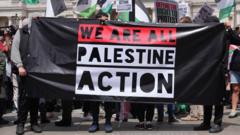
UK Government Defends Palestine Action Ban After High Court Ruling
Translated from English, summarized and contextualized by DistantNews.
TLDR
- The UK government is defending its ban on the activist group Palestine Action, which was declared unlawful by the High Court.
- The Court of Appeal is reviewing the government's decision to proscribe the group under anti-terrorism legislation.
- Palestine Action, founded in 2020, has targeted the UK subsidiary of Israel's Elbit defense firm, most recently vandalizing jets at RAF Brize Norton.
The British government is mounting a robust defense of its decision to ban Palestine Action, a proscribed organization under anti-terrorism laws, even after the High Court ruled the ban unlawful. This legal battle, now before the Court of Appeal, centers on whether the government's counter-terrorism powers were appropriately exercised. The government's legal team argues that overturning the ban would significantly curtail ministers' ability to combat terrorism, emphasizing that while Palestine Action may not be on the scale of groups like Hamas or the IRA, its activities warrant such measures.
The government's lawyer also told the court Palestine Action was 'not Hamas or the IRA, where there is an almost unique overlap between those who are engaged in the terrorist activity and those who support it'.
Central to the government's argument is the assertion that Palestine Action "met the statutory definition of being concerned in terrorism." The legal team highlighted that expert advice indicated the group's activities were escalating in seriousness. Despite the High Court's finding that the group "promotes its political cause through criminality and encouragement of criminality," the judges concluded that these actions did not justify a ban under terrorism legislation. The government's appeal seeks to challenge this interpretation, asserting parliamentary intent that ministers have broad discretion in such matters.
The rights of those who would otherwise wish to support Palestine Action are affected... maybe they don't even support the more extreme activities and/or wing of Palestine Action. But the whole nature and structure of the proscription regime is designed to recognise that there is value in preventing precisely that sort of support.
From a UK perspective, this case touches upon sensitive issues of protest rights versus national security. Palestine Action, which has been active since 2020, has focused its efforts on targeting Elbit Systems, an Israeli defense company with a significant UK presence. Their recent actions, including the vandalism of military jets at RAF Brize Norton, have drawn sharp criticism and led to the proscription. The legal challenge, however, raises important questions about the definition of terrorism, the scope of protest, and the government's powers to restrict activist groups. The government's defense underscores its commitment to maintaining national security, while acknowledging the potential impact on legitimate demonstrators, a balancing act that is constantly under scrutiny in a democratic society.
Palestine Action met the statutory definition of being concerned in terrorism.
DistantNews Editorial
Originally published by BBC News in English. Translated, summarized, and contextualized by our editorial team with added local perspective. Read our editorial standards.
More Stories


From Our Blog

What Gets Lost (and Found) When News Is Translated

The Critical Role of Diaspora Media in Global News

What Travellers Should Know About Countries with Restricted Press

A Digital Nomad's Guide to Following Local News

How the Same Story Looks Different in Different Countries
