


UN Chief Warns Hormuz Closure 'Strangling' Global Economy
Translated from English, summarized and contextualized by DistantNews.
TLDR
- UN Secretary General Antonio Guterres warned that the closure of the Strait of Hormuz is 'strangling the global economy' and could lead to widespread poverty and hunger.
- Guterres stated that even lifting restrictions immediately would require months for supply chains to recover, leading to prolonged low economic output and high prices.
- The UN chief cautioned that prolonged disruptions could push tens of millions into poverty, increase extreme hunger, and potentially trigger a global recession with severe social and political instability.
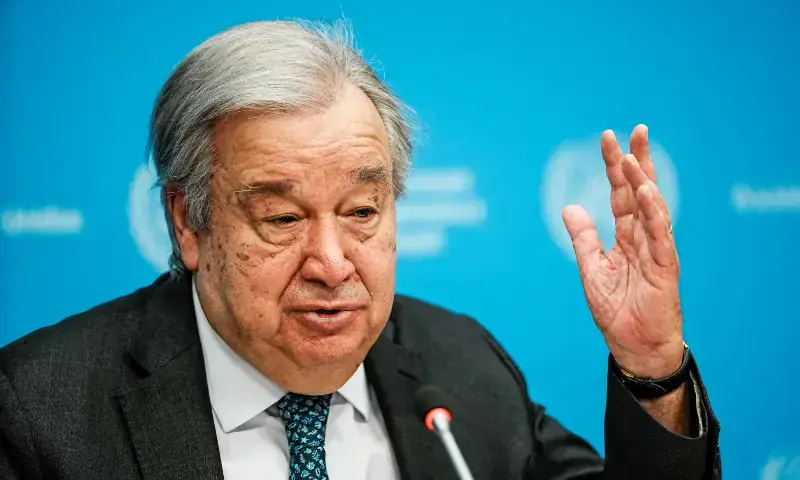
United Nations Secretary General Antonio Guterres issued a stark warning on Thursday regarding the escalating crisis in the Strait of Hormuz, describing its closure as a direct stranglehold on the global economy. In remarks to the press, Guterres emphasized that the disruption of this vital waterway, a critical chokepoint for global trade, is impeding the delivery of essential commodities like oil, gas, and fertilizer. The consequences, he cautioned, extend far beyond mere economic slowdown, threatening to plunge tens of millions into poverty and exacerbate global hunger.
The closure of the vital waterway is “strangling the global economy,”
Guterres outlined three potential trajectories for the world economy, already strained by a pandemic and the war in Ukraine. In the best-case scenario, global growth would dip slightly, accompanied by rising inflation and slowing trade. However, he warned that continued disruptions, stemming from Iranian actions and a U.S. blockade of Iranian ports, could lead to a significantly bleaker outlook. Under such circumstances, 32 million people could be pushed into poverty, and an additional 45 million could face extreme hunger due to fertilizer shortages and falling crop yields, potentially reversing hard-won development gains.
supply chains will take months to recover, prolonging lower economic output and higher prices,
The most dire scenario, Guterres warned, involves severe disruptions persisting through the end of the year, potentially ushering in a global recession with devastating impacts on economic, political, and social stability. He stressed that these consequences are not merely additive but exponential, meaning the longer the Strait remains choked, the more difficult it will be to reverse the damage. The UN chief's message to all parties involved was unequivocal: navigational rights and freedoms must be restored immediately. "Open the Strait. Let all ships pass. Let the global economy breathe again," he urged.
32 million people would be pushed into poverty, 45 million more would face extreme hunger as fertiliser runs low and crop yields fall, and “hard-won development gains” could be reversed overnight.
From our perspective at Dawn, Guterres's warning underscores the profound interconnectedness of the global community and the disproportionate impact that regional conflicts can have on international stability. While Western media often focuses on the geopolitical implications for major powers, the UN chief's emphasis on poverty, hunger, and reversed development gains highlights the human cost borne by vulnerable populations worldwide. The situation in the Strait of Hormuz is not just a matter of energy security for industrialized nations; it is a critical lifeline for global food security and poverty reduction, and its closure represents a grave threat to the progress made in achieving sustainable development goals.
we confront the spectre of a global recession with dramatic impacts on people, on the economy, and on political and social stability,
DistantNews Editorial
Originally published by Dawn in English. Translated, summarized, and contextualized by our editorial team with added local perspective. Read our editorial standards.
More Stories


From Our Blog

What Gets Lost (and Found) When News Is Translated

The Critical Role of Diaspora Media in Global News

What Travellers Should Know About Countries with Restricted Press

A Digital Nomad's Guide to Following Local News

How the Same Story Looks Different in Different Countries
