


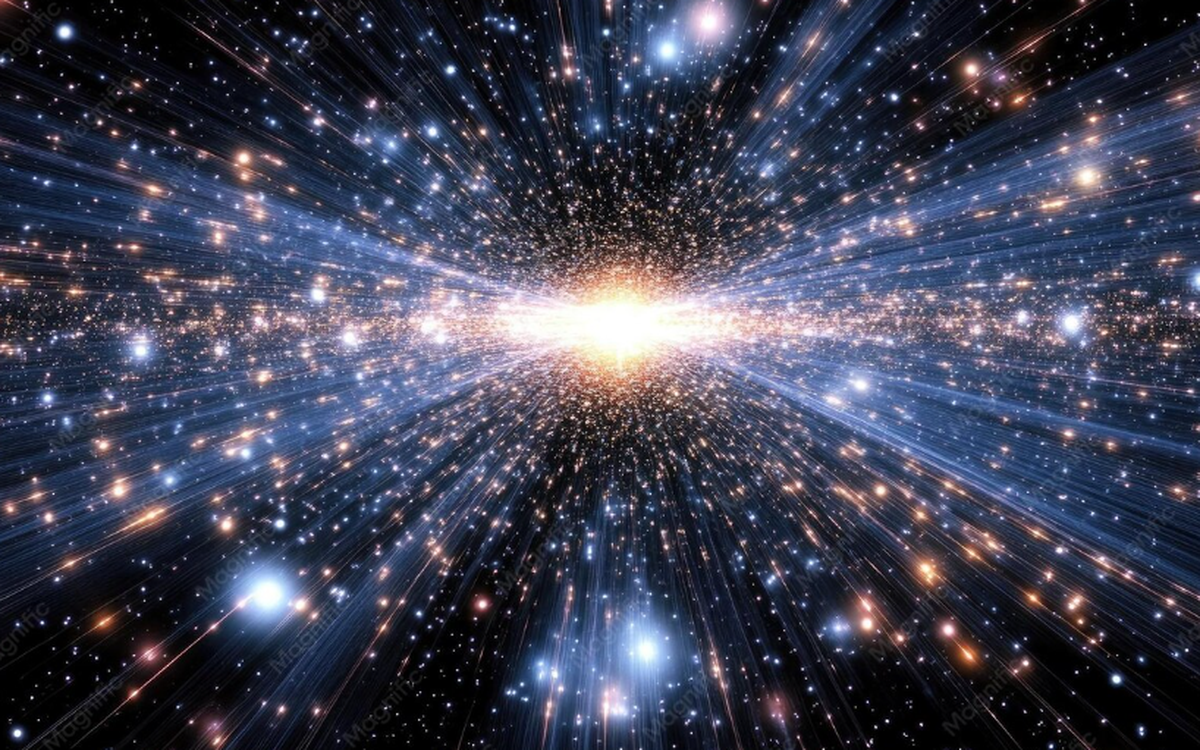
Universe Expanding 10% Faster Than Predicted, Baffling Scientists
Translated from Vietnamese, summarized and contextualized by DistantNews.
TLDR
- A new international study reveals the universe is expanding about 10% faster than previously predicted.
- The findings challenge the standard cosmological model and raise questions about dark matter and dark energy.
- This discovery prompts scientists to seek new theories to better understand the universe's origins and ultimate fate.
A groundbreaking international study, published in Astronomy and Astrophysics, has sent ripples through the scientific community by revealing that the universe's expansion rate is approximately 10% faster than current models predict. This significant discrepancy challenges the established cosmological model, which has long served as the bedrock for understanding the universe's mechanics.
Researchers Caroline Huang, Stefano Casertano, and Dillon Brout aimed to precisely measure the universe's expansion since the Big Bang. Their findings indicate a direct correlation: the farther away galaxies are, the faster they recede from us. For instance, a galaxy 3 million light-years away moves at about 74 km/s, while one twice that distance recedes at roughly 145 km/s. This observed speed significantly outpaces the predictions of the standard model.
According to Casertano, this deviation suggests that current models may be missing a crucial, yet poorly understood, element. Dark matter and dark energy are the leading hypotheses to explain this phenomenon. The study's implications extend to theories about the universe's future, including the 'heat death' scenario, potentially altering timelines for cosmic cooling and darkness.
This discovery is not just a scientific curiosity; it's a call to arms for theoretical physicists. The findings are actively pushing researchers to explore novel theories that can reconcile these observations, offering a clearer picture of the universe's genesis and its ultimate destiny. The implications for our understanding of cosmic evolution are profound, urging a re-evaluation of our most fundamental assumptions about the cosmos.
the deviation may indicate that current models are missing a crucial element that is not yet well understood, with dark matter and dark energy being the most discussed hypotheses.
DistantNews Editorial
Originally published by Tuổi Trẻ in Vietnamese. Translated, summarized, and contextualized by our editorial team with added local perspective. Read our editorial standards.
More Stories



From Our Blog

What Gets Lost (and Found) When News Is Translated

The Critical Role of Diaspora Media in Global News

What Travellers Should Know About Countries with Restricted Press

A Digital Nomad's Guide to Following Local News

How the Same Story Looks Different in Different Countries
