


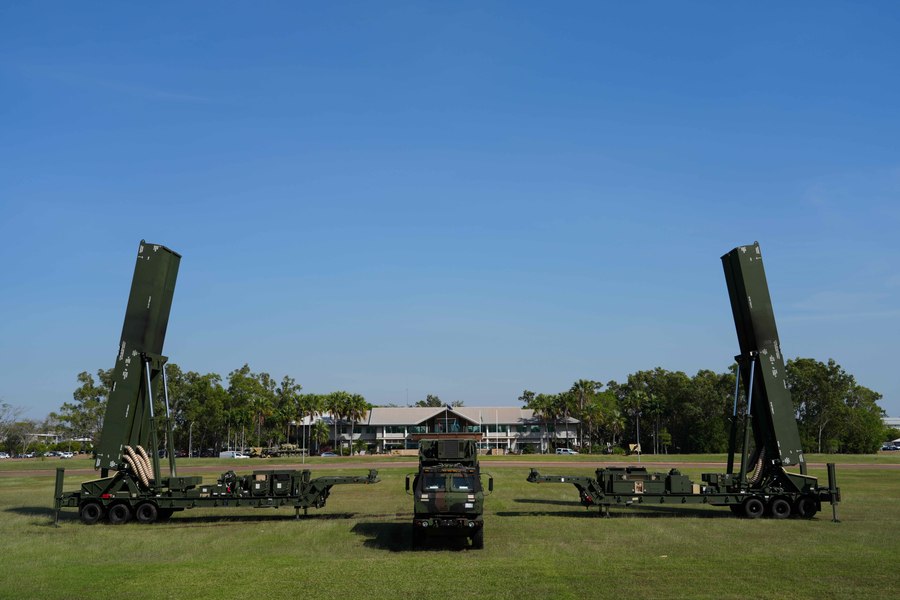
US Considers First Deployment of 'Dark Eagle' Hypersonic Weapon to Middle East
Translated from Romanian, summarized and contextualized by DistantNews.
TLDR
- The U.S. is considering its first-ever deployment of the 'Dark Eagle' hypersonic weapon to the Middle East, as the system achieves initial operational capability.
- The U.S. Central Command (CENTCOM) reportedly requested the deployment due to concerns about Iran moving ballistic missile launchers beyond the range of existing U.S. systems.
- This move signifies a major shift in U.S. military strategy, enhancing its long-range strike capabilities in a volatile region, despite the high cost of the weapon system.
The United States is on the cusp of a significant military development, potentially deploying its new 'Dark Eagle' Long Range Hypersonic Weapon (LRHW) to the Middle East. This marks a pivotal moment as the U.S. Army officially integrates this advanced, long-range strike system into its arsenal after years of development and delays.
The United States is analyzing the possibility of deploying for the first time the 'Dark Eagle' hypersonic weapon in the Middle East, as the U.S. Army introduces this long-range attack system into service after years of delays.
The reported request by U.S. Central Command (CENTCOM) stems from escalating concerns over Iran's ballistic missile capabilities. Intelligence suggests Iran has repositioned launchers, potentially placing them beyond the reach of current U.S. assets, including the Precision Strike Missile (PrSM). The 'Dark Eagle,' capable of speeds exceeding Mach 5 and maneuvering in flight, offers a formidable response, significantly extending the U.S. military's reach and reducing reaction times against elusive targets.
the U.S. Central Command (CENTCOM) reportedly requested the deployment of the Long Range Hypersonic Weapon (LRHW) system, nicknamed 'Dark Eagle,' to the region.
This potential deployment underscores a strategic pivot by the Pentagon, aiming to bolster its power projection in a region fraught with tension. The 'Dark Eagle' system, with its ability to strike targets over 2,700 kilometers away, represents a substantial leap in U.S. offensive capabilities. However, this technological advancement comes at a steep price, with individual missiles estimated at $15 million and a full battery costing around $2.7 billion, raising questions about the economic feasibility alongside the strategic imperative.
the system has reached initial operational capability, marking a first for the U.S., in which the U.S. Army has a ground-based hypersonic weapon ready for possible use.
While official confirmation of the deployment remains pending, the context is undeniably tense. The U.S. and Iran are currently observing a fragile de-escalation, with hopes for renewed nuclear negotiations. The introduction of such a potent weapon system into this delicate balance could dramatically alter regional dynamics. From a U.S. perspective, this is about maintaining deterrence and ensuring military superiority in a critical geopolitical theater. The ability to rapidly strike high-value targets with unprecedented speed and precision is seen as essential for safeguarding American interests and allies in the Middle East.
Iranian ballistic missile launchers have been moved beyond the range of existing American systems, including the Precision Strike Missile (PrSM) ground-to-ground missile, capable of hitting targets over 480 kilometers away.
DistantNews Editorial
Originally published by Adevărul in Romanian. Translated, summarized, and contextualized by our editorial team with added local perspective. Read our editorial standards.
More Stories



From Our Blog

What Gets Lost (and Found) When News Is Translated

The Critical Role of Diaspora Media in Global News

What Travellers Should Know About Countries with Restricted Press

A Digital Nomad's Guide to Following Local News

How the Same Story Looks Different in Different Countries
