


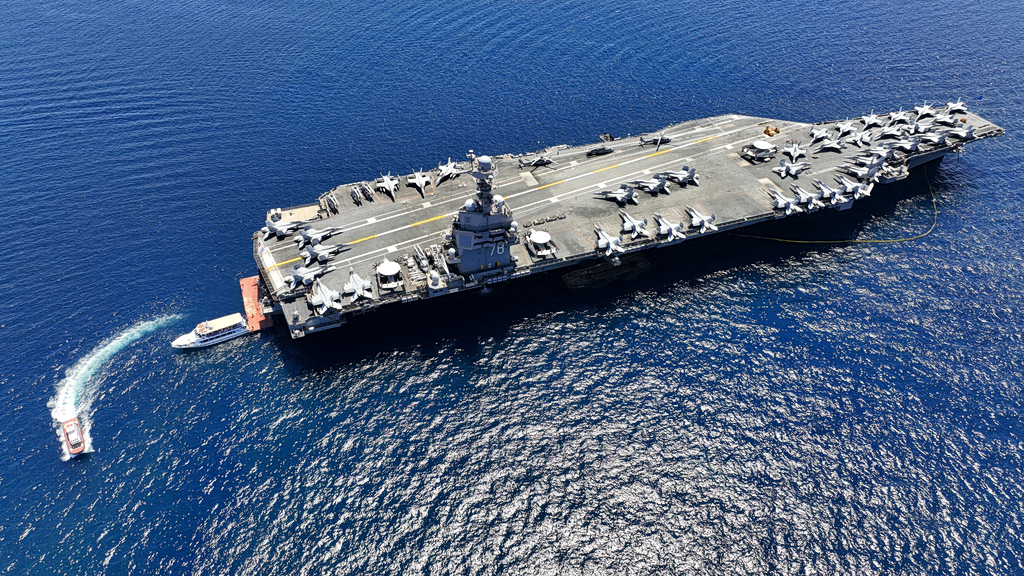
US Navy Faces Uphill Battle to Maintain Maritime Dominance Amidst Growing Threats
Translated from Greek, summarized and contextualized by DistantNews.
TLDR
- The U.S. Navy faces a significant challenge in maintaining maritime dominance due to an insufficient number of ships and a weakened shipbuilding industry.
- Growing tensions with China in the Pacific, the crisis with Iran, and the strain on Middle Eastern shipping necessitate an urgent increase in U.S. naval capacity.
- The U.S. is shifting its strategy to prioritize the production of more numerous, less complex vessels like frigates and unmanned craft, alongside traditional powerful warships, to counter China's rapid naval expansion.
The United States is facing a stark reality: its once unassailable naval supremacy is eroding. For the first time since the Cold War, Washington is grappling with the unsettling prospect of not having enough ships to project power globally, nor the industrial might to build them quickly enough. This isn't just a hypothetical concern; it's a pressing issue fueled by escalating tensions in the Middle East, particularly with Iran, and the ever-present challenge posed by China's relentless naval expansion in the Pacific.
The core of the problem lies in the American shipbuilding industry's limitations. For decades, the focus has been on constructing a smaller number of incredibly sophisticated and expensive vessels, such as aircraft carriers and nuclear submarines. While these platforms are formidable, they are time-consuming and astronomically costly to produce. This strategy, however, is proving insufficient against a rival like China, which is churning out warships at an unprecedented rate, already boasting the world's largest fleet and continuing to expand.
In response, the U.S. Navy is recalibrating its approach. The emphasis is shifting from solely building a few
DistantNews Editorial
Originally published by Ta Nea in Greek. Translated, summarized, and contextualized by our editorial team with added local perspective. Read our editorial standards.
More Stories

From Our Blog

What Gets Lost (and Found) When News Is Translated

The Critical Role of Diaspora Media in Global News

What Travellers Should Know About Countries with Restricted Press

A Digital Nomad's Guide to Following Local News

How the Same Story Looks Different in Different Countries
