

Venezuela Acknowledges Political Prisoner's Death After Year-Long Disappearance
Translated from Spanish, summarized and contextualized by DistantNews.
TLDR
- Venezuela's Ministry of Penitentiary Services confirmed the death of political prisoner Víctor Hugo Quero Navas nine months after his passing and over a year after his family reported him missing.
- Quero, 51, died on July 24, 2025, from respiratory failure after being transferred to a military hospital, according to the ministry.
- His mother, Carmen Navas, has requested a DNA test to confirm the body's identity, and the Venezuelan Prosecutor's Office has opened a criminal investigation and ordered an exhumation.
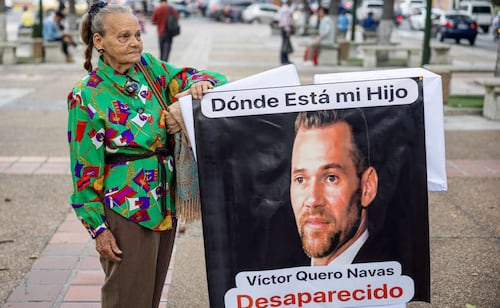
The Venezuelan government has finally acknowledged the death of political prisoner Víctor Hugo Quero Navas, a confirmation that comes a staggering nine months after his demise and more than a year after his family began a desperate search following his forced disappearance. This belated recognition, announced by the Ministry of Penitentiary Services, underscores the profound lack of transparency and the anguish faced by families seeking information about their detained loved ones in Venezuela.
Venezuela reconoció este jueves la muerte del preso político Víctor Hugo Quero Navas nueve meses después del deceso y tras más de un año de desaparición forzada denunciada por su familia
Quero, aged 51, reportedly died on July 24, 2025, at the Dr. Carlos Arvelo Military Hospital in Caracas. The official cause cited is respiratory failure, following an earlier diagnosis of upper digestive bleeding and acute febrile syndrome. However, the circumstances surrounding his death and the delay in notification raise serious concerns, particularly for a man who was excluded from the amnesty initiative promoted by interim president Delcy Rodríguez.
Quero, de 51 años, fue excluido de la amnistía impulsada por la presidenta interina de Venezuela, Delcy Rodríguez, de acuerdo con su defensa.
His 81-year-old mother, Carmen Navas, has been relentless in her pursuit of truth. Upon being taken to the burial site in Caracas's Parque Memorial Jardín La Puerta, she placed flowers and immediately requested a DNA test to definitively confirm the identity of the remains. The stark reality of the burial site, marked by a few stones and a dilapidated iron sheet, offers little comfort and highlights the state's failure to provide even basic dignity to the deceased and their families.
pidió que se practique una prueba de ADN para corroborar la identidad del cuerpo.
The Venezuelan Prosecutor's Office has announced a criminal investigation and ordered the prompt exhumation of the body, a step that, while necessary, comes far too late for many. Human rights activists have previously reported that dozens of families remain without news of arrested relatives, with many facing prolonged periods of forced disappearance. While Foro Penal reports that 776 political prisoners have been released since January, including 186 after the February amnesty law, the case of Víctor Hugo Quero Navas serves as a grim reminder of those still unaccounted for and the systemic issues plaguing the Venezuelan justice and penitentiary systems.
Quero falleció el 24 de julio de 2025 cerca de la medianoche "por insuficiencia respiratoria" luego de ser trasladado al Hospital Militar Dr. Carlos Arvelo, en Caracas, "tras presentar hemorragia digestiva superior y síndrome febril agudo".
DistantNews Editorial
Originally published by El Universal in Spanish. Translated, summarized, and contextualized by our editorial team with added local perspective. Read our editorial standards.
More Stories

From Our Blog

What Press Freedom Means for the News You Read

What Gets Lost (and Found) When News Is Translated

The Critical Role of Diaspora Media in Global News

What Travellers Should Know About Countries with Restricted Press

A Digital Nomad's Guide to Following Local News
