


Wage gap between regular and non-regular workers widens to 10-year high in South Korea
Translated from Korean, summarized and contextualized by DistantNews.
TLDR
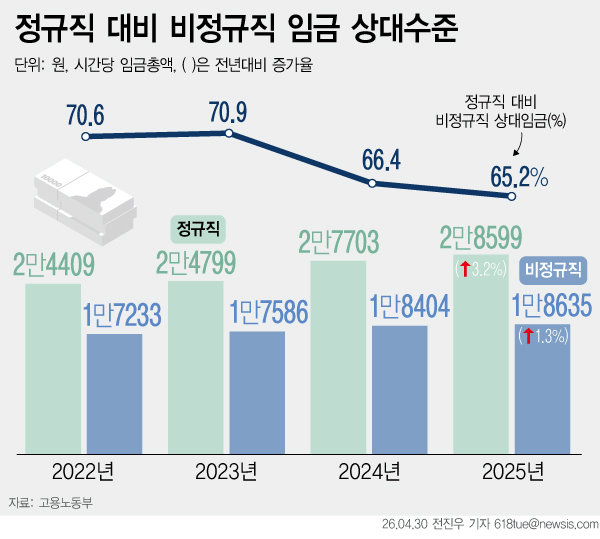
- The wage gap between regular and non-regular workers in South Korea widened in the past year, with non-regular workers earning 65.2% of regular workers' hourly wages.
- This marks the largest gap in a decade, as regular workers saw a 3.2% increase in hourly wages while non-regular workers' wages rose only 1.3%.
- The widening gap is attributed to an increase in non-regular positions in sectors with shorter working hours and lower pay, such as elderly care and social welfare, alongside faster wage growth for regular employees.
New data from the Ministry of Employment and Labor reveals a concerning trend: the wage disparity between regular and non-regular workers in South Korea has reached its widest point in a decade. In the past year, non-regular employees earned only 65.2% of the hourly wage of their regular counterparts, a decrease from 66.4% the previous year. This translates to a significant difference, where for every 1 million won earned by a regular worker, a non-regular worker performing the same hours would receive approximately 650,000 won.
The statistics show a stark contrast in wage growth. While regular workers saw their hourly wages increase by a respectable 3.2%, non-regular workers experienced a much smaller gain of just 1.3%. This divergence is further exacerbated by the types of jobs increasingly filled by non-regular workers. The Ministry points to a rise in non-regular positions in sectors like elderly care and social welfare, as well as an increase in part-time and older worker employment, which inherently come with lower pay scales.
This widening gap is a significant issue for social equity in South Korea. While international coverage might focus on headline GDP figures or technological advancements, the reality on the ground for a substantial portion of the workforce is one of increasing economic precarity. The data also highlights a persistent wage gap based on company size, with workers in small and medium-sized enterprises earning significantly less than those in large corporations. Although the gender pay gap has narrowed to its lowest point, the disparity based on employment type remains a critical challenge that demands attention and policy intervention to ensure fairer labor practices and a more equitable distribution of economic gains.
DistantNews Editorial
Originally published by Dong-A Ilbo in Korean. Translated, summarized, and contextualized by our editorial team with added local perspective. Read our editorial standards.
More Stories


From Our Blog

What Gets Lost (and Found) When News Is Translated

The Critical Role of Diaspora Media in Global News

What Travellers Should Know About Countries with Restricted Press

A Digital Nomad's Guide to Following Local News

How the Same Story Looks Different in Different Countries
