


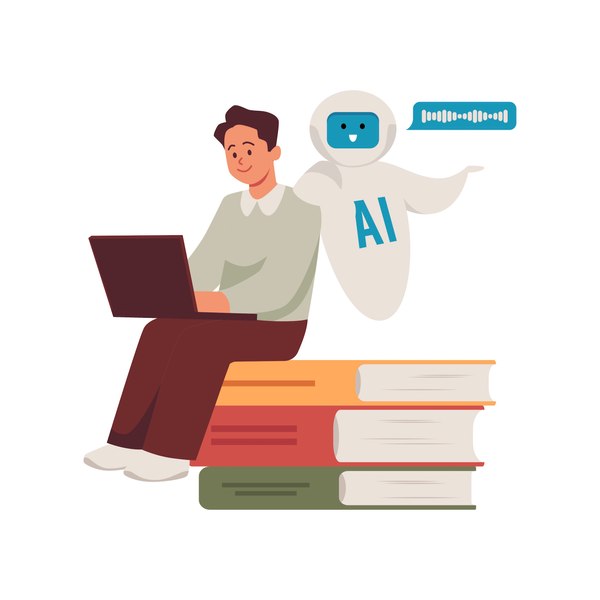
What is lost when books are no longer written only by humans? Mihai Mitrică: 'At the base of AI lies intellectual theft'
Translated from Romanian, summarized and contextualized by DistantNews.
TLDR
- The increasing use of Artificial Intelligence (AI) in book publishing is blurring the lines between human authors and algorithms.
- Concerns are rising about intellectual property rights, accountability, and the potential loss of human creativity and diverse voices.
- Experts like Mihai Mitrică and Constantin Vică emphasize the need for transparency with readers and the crisis facing copyright law.
The literary world is at a crossroads as Artificial Intelligence rapidly integrates into the book publishing process, raising profound questions about authorship, originality, and the very essence of human creativity. From generating illustrations in seconds to composing entire texts, AI's presence is becoming increasingly palpable, yet often invisible to the reader.
Human creativity is the most precious asset we have at the base of copyright.
Mihai Mitrică, executive director of the Romanian Publishers Association, observes that AI is making inroads into the Romanian market, particularly in illustration. He notes a concerning trend where children seem to respond more favorably to AI-generated images than to human-created art. Mitrică warns that this could lead to a cultural risk, where the unique, individual signatures of human artists are lost, replaced by a redundant, uniform aesthetic dictated by algorithms. He stresses that human creativity is the most valuable asset underpinning copyright law, and its erosion is a significant concern.
Constantin Vică, a university lecturer specializing in applied ethics, echoes these concerns, highlighting the critical importance of transparency. Both experts agree that the current situation poses a crisis for copyright and risks diminishing the diversity of human voices in literature. The question of who owns a book written with AI assistance, and who is accountable when things go wrong, remains largely unanswered, leaving illustrators, translators, and editors in a precarious position.
We will end up standardizing, having the same redundant typology of AI, of illustrations, if we continue this way.
From a Romanian perspective, as discussed in "Weekend Adevărul," this technological shift is viewed with a mixture of fascination and apprehension. The potential for efficiency and new forms of creativity is acknowledged, but the ethical and cultural implications are paramount. The emphasis on transparency and the defense of human authorship reflect a deep-seated value placed on individual expression and the integrity of cultural production. This conversation is particularly relevant in Romania, a country with a rich literary tradition, where the preservation of unique voices and artistic integrity is seen as crucial for maintaining cultural identity in the face of rapid technological advancement. The potential for AI to homogenize creative output is a threat that resonates strongly within a society that values nuanced and diverse storytelling.
Transparency towards the reader matters enormously, copyright is in crisis, and what is lost and is most difficult to recover is precisely the diversity of human voices.
DistantNews Editorial
Originally published by Adevărul in Romanian. Translated, summarized, and contextualized by our editorial team with added local perspective. Read our editorial standards.
More Stories
From Our Blog

What Gets Lost (and Found) When News Is Translated

The Critical Role of Diaspora Media in Global News

What Travellers Should Know About Countries with Restricted Press

A Digital Nomad's Guide to Following Local News

How the Same Story Looks Different in Different Countries
