


Why 'Made in Singapore' Remains a Strategic Business Choice for Food Manufacturers
Translated from English, summarized and contextualized by DistantNews.
TLDR
- Singapore's food manufacturing sector is strategically keeping some production within the country despite shifting labor-intensive processes to lower-cost regions like China and Malaysia.
- Companies cite Singapore's brand name, market access, and stable regulations as key reasons for maintaining local operations, contributing to higher value-added jobs.
- While some major brands are scaling down local operations, the sector overall has exceeded job creation projections through innovation and R&D, contributing significantly to the national economy.
Singapore's food manufacturing sector demonstrates a nuanced approach to global production trends. While it's pragmatic to shift labor-intensive tasks to more cost-effective locations in the region, the decision to retain certain production lines within Singapore is a deliberate business strategy. This isn't just about sentiment; it's about leveraging the 'Made in Singapore' brand, which carries significant weight in international markets. The country's stable regulatory environment and access to global trade networks further bolster this strategy.
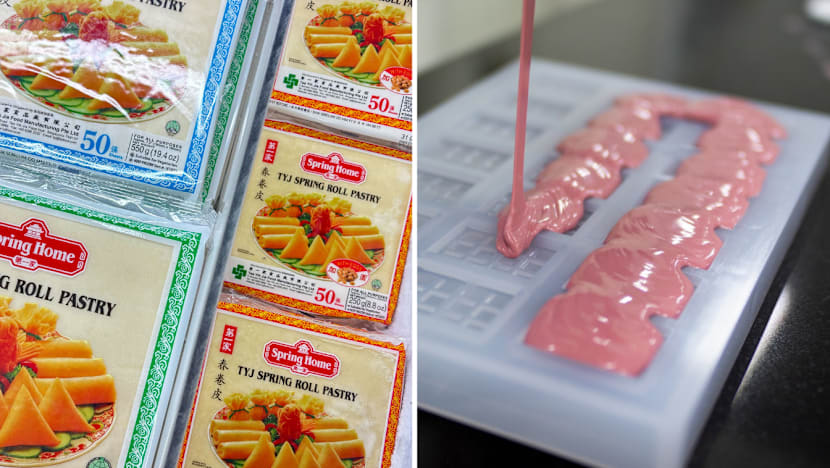
producing spring roll skins and roti prata in Singapore is a point of pride as well as a business strategy.
This approach highlights a sophisticated understanding of value chains. Instead of a race to the bottom on cost, Singapore focuses on higher-value activities. This includes not only maintaining specific production capabilities but also investing in research and development and workforce transformation. Enterprise Singapore's data showing the sector exceeding job creation targets underscores this success. These aren't just any jobs; they are higher value-added roles that align with Singapore's broader economic ambitions.
Singapore’s cost base for labour, industrial space and energy is persistently higher than neighbouring markets.
While the closure of some operations by household names like Yeo's and APB Singapore might seem concerning, it's crucial to view this within the larger context. The food manufacturing sector, while not an 'advanced manufacturing' engine like semiconductors or biomedical sciences, remains a vital contributor to Singapore's economy. Its continued growth in higher-skilled jobs, despite the outward shift of some production, showcases a resilient and adaptive industry. The 'Made in Singapore' label, therefore, continues to be a powerful differentiator, enabling local firms to compete effectively on a global stage.
The transition towards advanced manufacturing is not intended to decrease the number of food manufacturing production lines in Singapore. Rather, the aim is to increase the productivity and competitiveness of the sector.
DistantNews Editorial
Originally published by CNA in English. Translated, summarized, and contextualized by our editorial team with added local perspective. Read our editorial standards.
More Stories


From Our Blog

What Gets Lost (and Found) When News Is Translated

The Critical Role of Diaspora Media in Global News

What Travellers Should Know About Countries with Restricted Press

A Digital Nomad's Guide to Following Local News

How the Same Story Looks Different in Different Countries
