


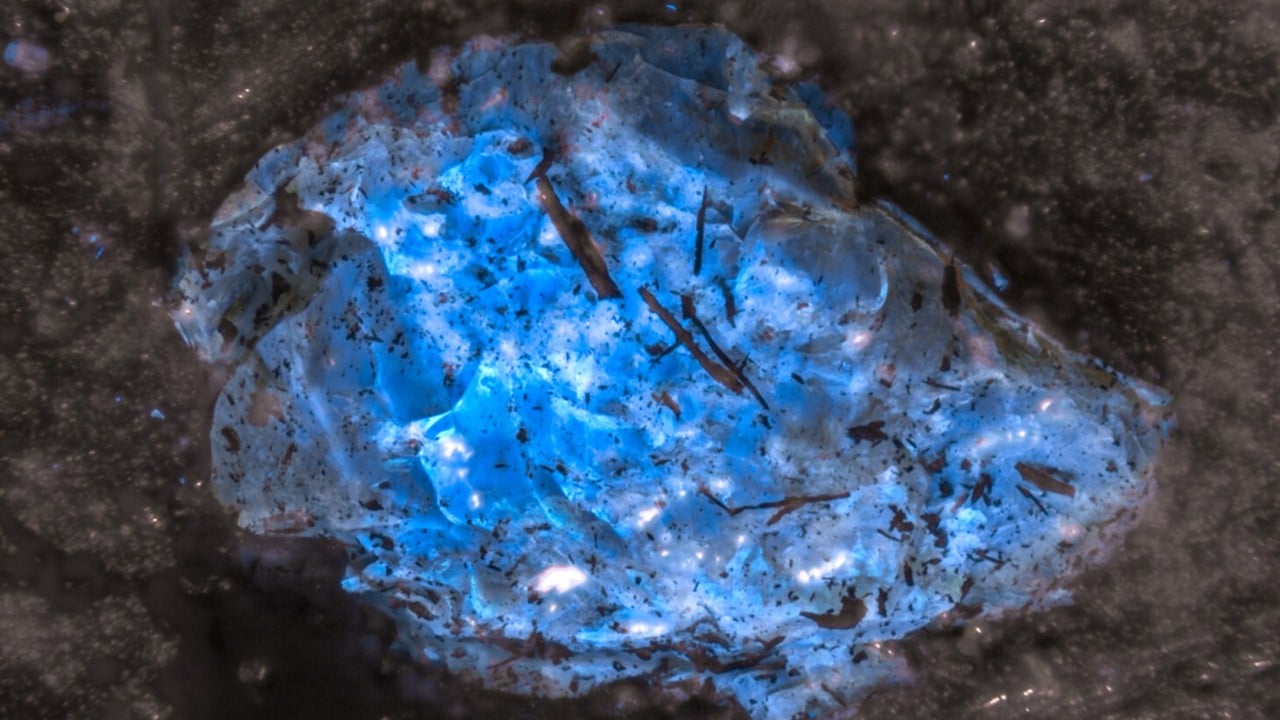
World's oldest amber unearthed by Chinese scientists in Xinjiang
Translated from English, summarized and contextualized by DistantNews.
At a glance
News
Documents & data
Context piece
- Chinese scientists discovered the world's oldest verified amber in Xinjiang, dating back 385 million years.
- This finding pushes back the known record of amber by about 65 million years, predating most animal groups.
- The amber was found in coal seams from the Middle Devonian period, challenging previous assumptions about the origins of plant resins.
Chinese scientists have unearthed the world's oldest verified amber in the northwestern Xinjiang region, revealing that ancient plants were producing protective resin 385 million years ago. This discovery significantly predates the emergence of most animal groups that could damage them.
The amber was found preserved in coal seams in West Junggar, an area known for its ancient geological activity where tectonic plates collided. This discovery pushes back the record for the oldest known amber by approximately 65 million years. Previously, the oldest confirmed amber dated to the Late Carboniferous period, around 320 million years ago, coinciding with the appearance of the first herbivores.
The research team, led by Luo Cihang from the Chinese Academy of Sciences’ Nanjing Institute of Geology and Palaeontology, published their findings in the peer-reviewed journal Science Advances. The paper details how palaeontologists were initially skeptical upon finding hundreds of microscopic amber pieces within a coal seam estimated to be from the Middle Devonian period, approximately 393 to 383 million years ago.
When Luo and his team visited Xinjiang in 2019, their objective was to examine and collect fossil samples from the region's unique coal seam. They did not anticipate that these samples would yield the oldest known amber, a finding that challenges long-held assumptions about the evolutionary timeline and origins of plant resins.
When the Chinese scientists observed what appeared to be pieces of amber embedded in the coal seam they were studying, their first reaction was excitement, followed by caution.
DistantNews Editorial
Originally published by South China Morning Post in English. Translated, summarized, and contextualized by our editorial team with added local perspective. Read our editorial standards.
More Stories

From Our Blog

Countries Without a Free Press: What You Need to Know

What Press Freedom Means for the News You Read

What Gets Lost (and Found) When News Is Translated

The Critical Role of Diaspora Media in Global News

What Travellers Should Know About Countries with Restricted Press
