


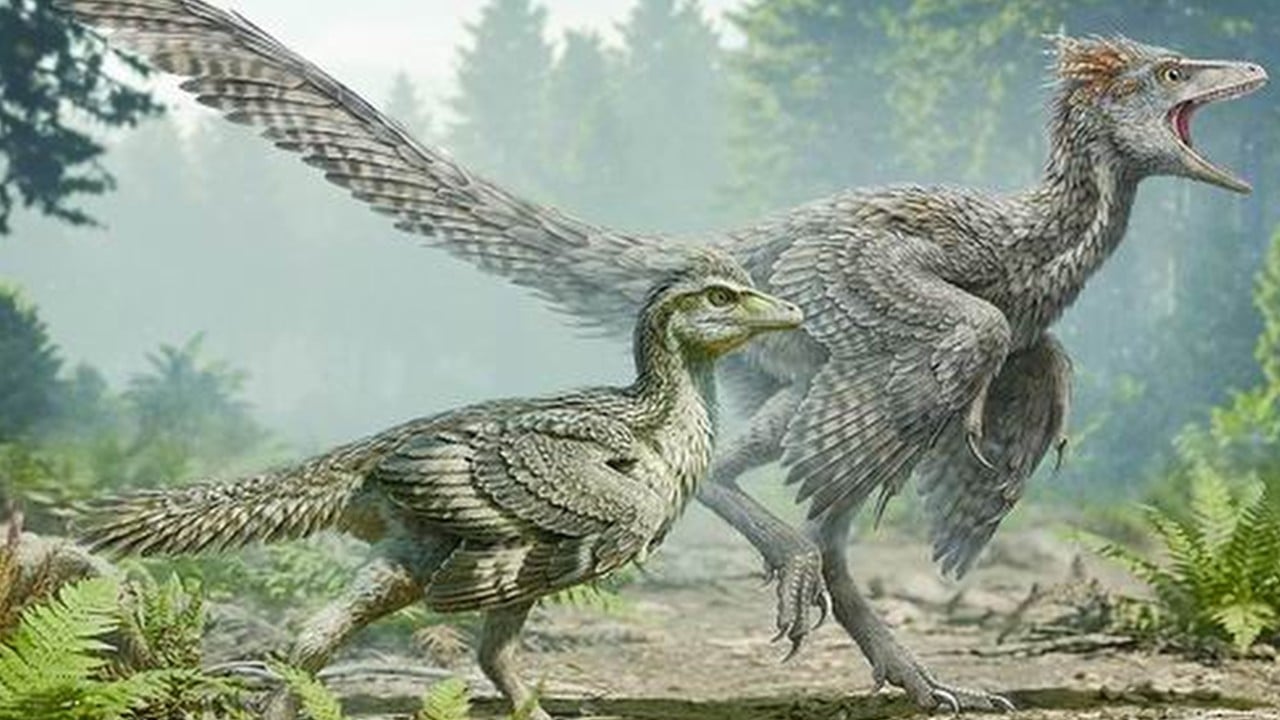
Chinese fossil find shows birds shed their dinosaur tails step by step
Summarized and contextualized by DistantNews.
At a glance
News
Named sources
Context piece
- A fossil discovery in China suggests birds evolved their short tails from dinosaur ancestors gradually, not suddenly.
- This transition to a short, feathered tail was crucial for bird survival after the extinction event 66 million years ago.
- Researchers identified a pygostyle, a fused tailbone structure, in early bird fossils, supporting the step-by-step evolution theory.
A fossil unearthed in China provides new evidence that modern birds gradually shed the long, bony tails of their dinosaur ancestors. This finding challenges the previous belief that the evolutionary transition to a short, feathered tail occurred suddenly.
The development of a short, pygostyle-bearing tail was a significant evolutionary step, enabling birds, the sole surviving lineage of dinosaurs, to thrive after the mass extinction event 66 million years ago. Researchers from the Chinese Academy of Sciences (CAS) and the Fujian Province Geological Science Research Institute published their findings in the journal Science Advances on July 1.
"The evolutionary assembly of the flight-adapted bird body plan encompasses some of the most profound morphological changes in terrestrial vertebrate history," the researchers stated. Unlike most non-avian dinosaurs, modern birds possess a pygostyle, a fused structure of the final tail vertebrae that anchors tail feathers and muscles, providing aerodynamic advantages and enabling tail fanning.
The evolutionary assembly of the flight-adapted bird body plan encompasses some of the most profound morphological changes in terrestrial vertebrate history.
Studying this transformation has been challenging due to the scarcity of fossils from early diverging birds and bird-like dinosaurs. The newly discovered fossil, however, offers crucial insights into the gradual process of tail reduction and modification.
The research highlights that the evolution of the pygostyle was not an instantaneous event but rather a series of incremental changes. This step-by-step process allowed for the development of the specialized tail structure vital for flight and maneuverability in modern birds, distinguishing them from their larger, long-tailed dinosaur relatives.
A short pygostyle-bearing tail is functionally and ecologically vital to living birds, which enables tail fanning and conveys aerodynamic advantages.
DistantNews Editorial
Originally published by South China Morning Post. Summarized and contextualized by our editorial team with added local perspective. Read our editorial standards.
More Stories


From Our Blog

Countries Without a Free Press: What You Need to Know

What Press Freedom Means for the News You Read

What Gets Lost (and Found) When News Is Translated

The Critical Role of Diaspora Media in Global News

What Travellers Should Know About Countries with Restricted Press
