


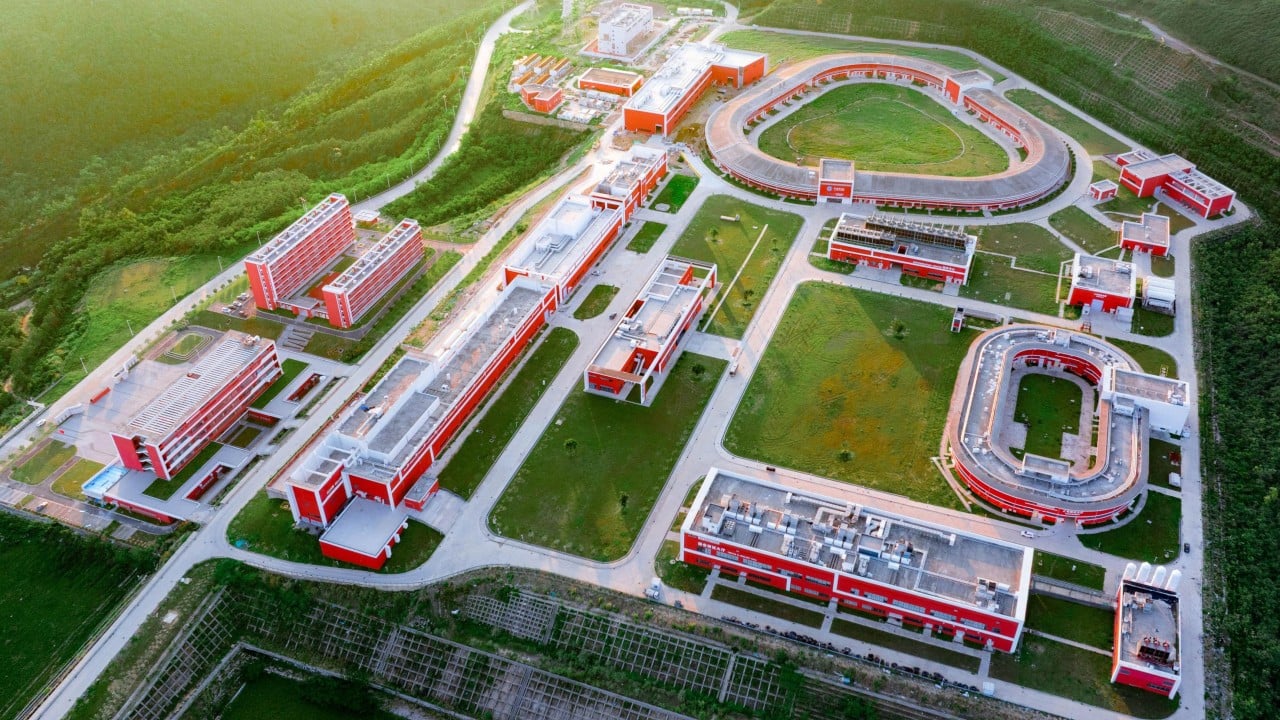
China fires up powerful particle accelerator to unlock secrets of atoms
Summarized and contextualized by DistantNews.
At a glance
News
From a news agency
New plan
- China has activated a record-breaking particle accelerator, the High Intensity Heavy-ion Accelerator Facility (HIAF), in Huizhou, Guangdong province.
- The facility, developed over 16 years, can produce the world's most intense beams of charged atoms, surpassing previous records held by a German accelerator.
- HIAF aims to advance research in areas such as cancer treatment and spacecraft materials by enabling the creation of previously unknown atomic nuclei.
China has officially launched its High Intensity Heavy-ion Accelerator Facility (HIAF), a state-of-the-art particle accelerator in Huizhou, Guangdong province. This facility boasts the world's most powerful beams of charged atoms, marking a significant advancement in scientific research capabilities. The activation follows 16 years of development by researchers at the Institute of Modern Physics in Lanzhou, Gansu, and their collaborators.
The HIAF is designed to push the boundaries of nuclear physics, enabling scientists to create novel atomic nuclei. This capability is expected to accelerate research in critical fields, including the development of more effective cancer treatments and the creation of advanced materials for spacecraft. The facility's scientific operations have commenced after its construction was completed earlier this week.
Boasting a price tag of 2.6 billion yuan (US$384.1 million), HIAF sets a new global benchmark. It can pack up to eight times more atoms into each pulse compared to the previous world record holder, a German particle accelerator located in Darmstadt. Unlike many similar facilities, HIAF integrates a 100-meter linear accelerator, a 570-meter circular accelerator, and advanced storage rings into a single, comprehensive complex, enhancing its research potential.
DistantNews Editorial
Originally published by South China Morning Post. Summarized and contextualized by our editorial team with added local perspective. Read our editorial standards.
More Stories

From Our Blog

Countries Without a Free Press: What You Need to Know

What Press Freedom Means for the News You Read

What Gets Lost (and Found) When News Is Translated

The Critical Role of Diaspora Media in Global News

What Travellers Should Know About Countries with Restricted Press
