


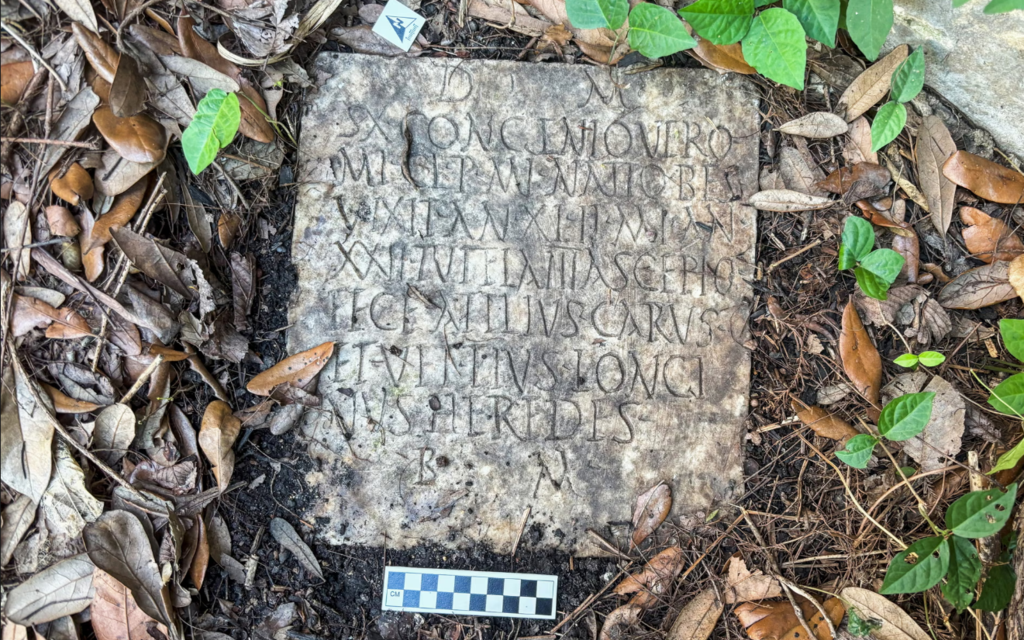
2,000-Year-Old Roman Funerary Stone Found in US Yard Returns to Italy with FBI Help
Translated from Greek, summarized and contextualized by DistantNews.
TLDR
- A nearly 2,000-year-old Roman funerary stone, discovered in a New Orleans backyard, has been returned to Italy.
- The marble stele, dedicated to Sextus Congenius Verus, a 2nd-century Roman sailor, was identified as a missing artifact from a museum in Civitavecchia.
- The FBI's Art Crime Team facilitated the repatriation, highlighting international cooperation in combating illicit trafficking of cultural goods.
The return of a nearly 2,000-year-old Roman funerary stone to Italy, following its discovery in a New Orleans backyard, is a significant moment for cultural heritage preservation. This marble stele, dedicated to Sextus Congenius Verus, a Roman sailor from the 2nd century, represents a tangible link to our ancient past. Its journey from a private garden in the United States back to its rightful place in Italy, facilitated by the FBI's Art Crime Team, underscores the importance of international collaboration in protecting cultural artifacts.
The discovery itself was serendipitous. Anthropologist Danielle Santoro and her husband Aaron Lorenz stumbled upon the inscribed stone while cleaning their garden. Their responsible action in contacting experts, including Professor Suzanne Lusnia of Tulane University, led to the identification of the artifact. This meticulous work, involving cross-referencing with museum records and historical accounts, ultimately confirmed the stele's origin and its status as a missing piece from the municipal museum of Civitavecchia.
The FBI works with international partners to combat the illegal trafficking of cultural property.
What makes this story particularly compelling from an Italian perspective is the narrative of loss and recovery. The stele's absence from the Civitavecchia museum, likely due to damage during World War II and subsequent loss of collection items, highlights the fragility of our heritage. The FBI's involvement, working alongside Italian authorities, demonstrates a shared commitment to rectifying historical injustices and ensuring that these invaluable pieces of history are accessible for study and appreciation. This repatriation is not just about returning an object; it's about restoring a piece of our collective memory and reinforcing the cultural ties that bind us.
The funerary stone was one of several items returned as part of the U.S.-Italy Cultural Property Agreement (CPA).
DistantNews Editorial
Originally published by Ta Nea in Greek. Translated, summarized, and contextualized by our editorial team with added local perspective. Read our editorial standards.
More Stories


From Our Blog

What Gets Lost (and Found) When News Is Translated

The Critical Role of Diaspora Media in Global News

What Travellers Should Know About Countries with Restricted Press

A Digital Nomad's Guide to Following Local News

How the Same Story Looks Different in Different Countries
