


2,500-year-old "warrior prince" tomb with chariot unearthed in Italy
Translated from Polish, summarized and contextualized by DistantNews.
At a glance
News
Official statement
New plan
- Archaeologists in Italy discovered a 2,500-year-old tomb belonging to a "warrior prince" of the ancient Piceni civilization.
- The tomb contains a chariot, helmet, and rich grave goods, offering insights into the burial rituals of the elite.
- This significant find is part of a larger necropolis and sheds new light on the mysterious Piceni people.
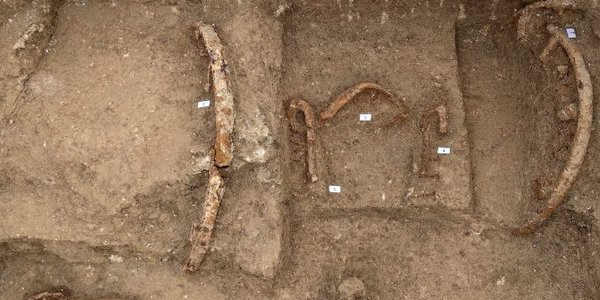
An extraordinary discovery has been made in Sirolo, Italy, where archaeologists unearthed a 2,500-year-old royal tomb belonging to a "warrior prince" of the pre-Roman Piceni civilization. The burial site, dating back to the 6th century BCE, was found with a chariot, a helmet, and an array of rich grave goods, providing invaluable insights into the funerary practices of this enigmatic Italic people.
The monumental tomb is situated within a vast necropolis and is distinguished by a circular wooden palisade, a feature previously unseen in known Piceni burial sites. This unique construction, located on a slight elevation, is believed to have emphasized the site's grandeur and symbolic importance. The deceased was interred with a wooden chariot, remarkably preserved over millennia, alongside a helmet and several bronze vessels containing organic remains, possibly from a funeral feast or food offerings.
Adjacent to the warrior prince's grave, archaeologists also discovered the burial of a woman. Her tomb was furnished with textiles, footwear, and numerous fibulae, metal clasps used for clothing. A particularly notable find was a large fibula adorned with amber, likely part of her hairstyle or headdress. This discovery is near the so-called "Queen's Tomb," where a Piceni woman was found in 1989 with two chariots, two mules, and extensive personal belongings.
While royal tombs have been uncovered in the Sirolo area for decades, this new necropolis has surprised researchers with its distinct architectural form. Unlike previously known Piceni cemeteries, which were typically bordered by ditches to separate the worlds of the living and the dead, this site features a wooden palisade. Archaeologists, led by Stefano Finocchi, are continuing their excavations, hoping to further illuminate the social structure and beliefs of the Piceni civilization, a people about whom written records are scarce.
DistantNews Editorial
Originally published by Rzeczpospolita in Polish. Translated, summarized, and contextualized by our editorial team with added local perspective. Read our editorial standards.
More Stories



From Our Blog

What Gets Lost (and Found) When News Is Translated

The Critical Role of Diaspora Media in Global News

What Travellers Should Know About Countries with Restricted Press

A Digital Nomad's Guide to Following Local News

How the Same Story Looks Different in Different Countries
