


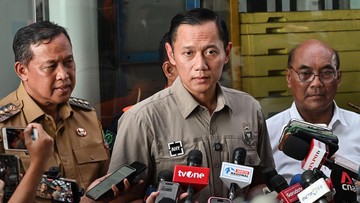
AHY on Women's Carriage Position: Men and Women Shouldn't Be Victims
Translated from Indonesian, summarized and contextualized by DistantNews.
TLDR
- Indonesia's Coordinating Minister for Infrastructure and Regional Development, Agus Harimurti Yudhoyono (AHY), addressed the positioning of women-only train carriages following a recent accident.
- He noted that the carriage designated for women's protection was unfortunately the most exposed during the collision.
- AHY emphasized that the government will evaluate the carriage placement, prioritizing overall passenger safety regardless of gender.
The recent collision involving the Argo Bromo train and a KRL commuter train at Bekasi Timur station has brought to the forefront a critical issue regarding the safety and placement of women-only carriages in Indonesia's public transportation system. Agus Harimurti Yudhoyono (AHY), the Coordinating Minister for Infrastructure and Regional Development, has acknowledged the public's concern and the government's commitment to evaluating the current arrangement of these dedicated carriages.
Yes, it has never happened before that a KRL was hit from behind by a long-distance train. And coincidentally, the rearmost was the women-only carriage.
Minister AHY pointed out the tragic irony that the carriage specifically designed to offer greater protection to female passengers ended up bearing the brunt of the impact from the rear. This unfortunate incident has raised questions about the effectiveness of the current design and placement, prompting a thorough review. The government is keen to understand why the most vulnerable passengers, for whom special provisions were made, experienced the highest fatality rate in this particular collision.
While the evaluation of carriage placement will be a part of the government's agenda, Minister AHY stressed a broader principle: ensuring the safety of all passengers, irrespective of gender. He articulated that the focus should not be on segregating passengers by gender but on fundamentally improving the safety and reliability of the entire public transportation system. The goal is to foster a sense of security and comfort for everyone using trains, making 'safety first' a tangible reality rather than just a slogan.
So there must be a concern why the most vulnerable, for whom we have prepared special carriages, are the ones who get the highest risk.
This incident highlights a unique challenge within Indonesia's context, where efforts to provide specific protections for women on public transport are being re-examined in light of safety outcomes. The government's response, balancing the need for targeted safety measures with a universal approach to public transport security, reflects a nuanced understanding of passenger needs and systemic improvements required.
This is also part of what we will continue to evaluate, but what is clear is that men and women are the same, they should not be victims in any incident. So what we are focusing on is not women and men, but how the train transportation system and other public transportation systems are safe, provide a sense of security, comfort, and also safety first, which is truly not just a slogan but can truly be implemented well.
DistantNews Editorial
Originally published by CNN Indonesia in Indonesian. Translated, summarized, and contextualized by our editorial team with added local perspective. Read our editorial standards.
More Stories


From Our Blog

What Gets Lost (and Found) When News Is Translated

The Critical Role of Diaspora Media in Global News

What Travellers Should Know About Countries with Restricted Press

A Digital Nomad's Guide to Following Local News

How the Same Story Looks Different in Different Countries
