


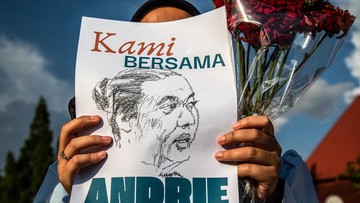
Andrie Yunus Seeks to Intervene in Lawsuit Challenging Military Justice Law
Translated from Indonesian, summarized and contextualized by DistantNews.
TLDR
- Victim of a military assault, Andrie Yunus, has requested to be a related party in a judicial review of the Military Justice Law.
- The case challenges the law's provisions regarding the trial of military personnel for general crimes.
- Yunus and his legal team argue that military personnel committing common crimes should be tried in civilian courts, not military ones, to ensure equality before the law.
In a significant development for human rights advocacy in Indonesia, Andrie Yunus, a victim of a brutal assault allegedly perpetrated by members of the Indonesian Military (TNI), has formally requested to be recognized as a related party in a constitutional challenge against the Military Justice Law. This legal maneuver, supported by the Advocacy Team for Security Sector Reform, aims to scrutinize Law Number 31 of 1997 concerning Military Justice. The core of the challenge lies in the law's alleged overreach, particularly Article 9, Paragraph (1), which reportedly fails to distinguish between military-specific offenses and general crimes. Yunus's legal team argues that this ambiguity allows military personnel who commit common crimes to be tried within the military justice system, rather than the more independent and transparent civilian courts.
This application is submitted for and on behalf of and representing Andrie Yunus, a citizen who is a victim of violence allegedly committed by a member of BAIS TNI.
This case transcends individual grievance, representing a broader struggle for justice and accountability within Indonesia's security sector. Yunus, known for his work as an activist and human rights defender, contends that the current legal framework undermines the principle of equality before the law, a cornerstone of a democratic state. The team highlights that while the TNI Law itself (Article 65, Paragraph 2) stipulates a separation of judicial regimes, the practical application through the Military Justice Law creates a conflict. This inconsistency, they argue, not only generates legal confusion but also obstructs victims' access to justice, potentially leading to constitutional losses for individuals like Yunus who are denied a trial in a public, civilian forum.
The handling of the case is directed into the jurisdiction of military justice.
The legal team emphasizes that the current system, where soldiers accused of common crimes are tried by military courts, is fundamentally at odds with the concept of a state governed by the rule of law. They assert that such a practice erodes public trust and hinders substantial progress in security sector reform. By seeking to be a party in this judicial review, Yunus and his supporters aim to ensure that all citizens, regardless of their background or the alleged perpetrator's affiliation, are subject to the same legal standards and have equal access to justice.
As a result, soldiers who commit general crimes are still tried in military forums, not in the more independent and open general courts.
DistantNews Editorial
Originally published by CNN Indonesia in Indonesian. Translated, summarized, and contextualized by our editorial team with added local perspective. Read our editorial standards.
More Stories


From Our Blog

What Gets Lost (and Found) When News Is Translated

The Critical Role of Diaspora Media in Global News

What Travellers Should Know About Countries with Restricted Press

A Digital Nomad's Guide to Following Local News

How the Same Story Looks Different in Different Countries
