


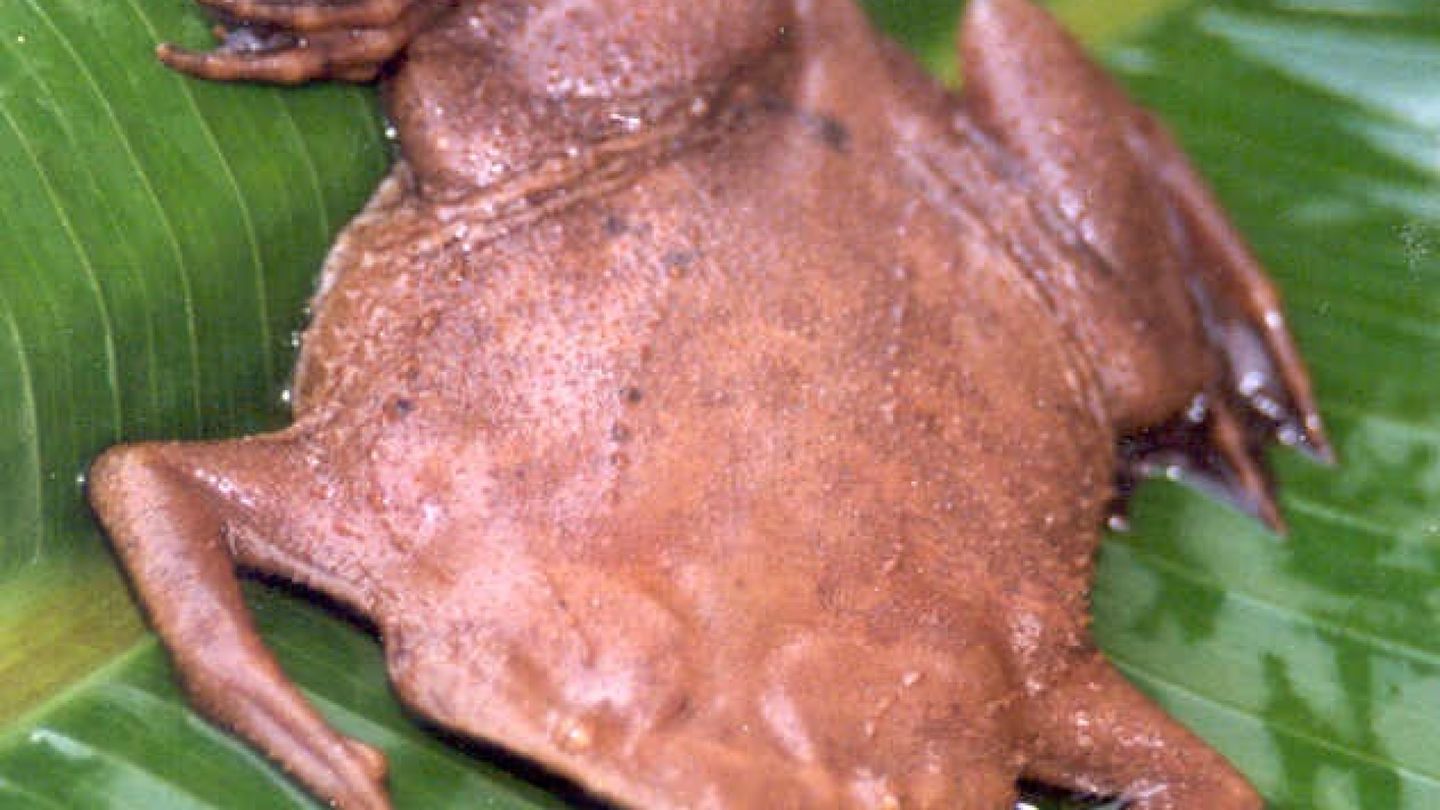
Animal of the Week: The Surinam Toad's Strange Motherhood – Growing Young on Its Back
Translated from Finnish, summarized and contextualized by DistantNews.
TLDR
- The Surinam toad, a species of frog, has a unique reproductive method where it carries its young in a honeycomb-like structure on its back.
- Dozens of offspring can develop simultaneously within the female's back skin, eventually emerging as fully formed froglets.
- This unusual maternal care strategy is highlighted in an article discussing different ways animals become mothers, contrasting it with simpler methods like budding in hydra polyps.
From the perspective of Helsingin Sanomat, this article offers a fascinating glimpse into the natural world, particularly focusing on the peculiar reproductive habits of the Surinam toad. The piece highlights the 'honeycomb' method of carrying tadpoles on the mother's back, a detail that is both biologically intriguing and visually striking, even prompting a mention of trypophobia (fear of holes).
The Surinam toad carries its young in a honeycomb structure on its back.
The article frames this as a Mother's Day reflection, contrasting the toad's complex method with the simpler reproduction of a hydra polyp. This juxtaposition serves to emphasize the diversity of life and the myriad ways in which creatures bring forth offspring. The tone is one of curious observation, with a touch of lightheartedness, as it speculates on the mother toad's potential sensations ('Does it tickle?').
One female can produce dozens of offspring at once.
While the scientific name 'Pipa pipa' is noted, the article also playfully connects it to Tampere, Finland, adding a local flavor to the global subject. The description of the adult toad as a 'flattened hamburger patty that pretends to be a dead leaf' is vivid and memorable, underscoring its camouflage abilities. The article also touches upon its feeding habits, describing how it 'inhales' prey, further detailing the unique adaptations of this amphibian.
We don't know what this mother toad feels.
This story, while about a creature found in Suriname, is presented in a way that engages a Finnish audience by emphasizing the sheer strangeness and wonder of nature. It's a reminder of the incredible evolutionary paths life can take, presented with a journalistic style that balances scientific fact with engaging, almost whimsical, description.
If you suffer from it, you shouldn't look at the toad's back.
DistantNews Editorial
Originally published by Helsingin Sanomat in Finnish. Translated, summarized, and contextualized by our editorial team with added local perspective. Read our editorial standards.
More Stories



From Our Blog

What Gets Lost (and Found) When News Is Translated

The Critical Role of Diaspora Media in Global News

What Travellers Should Know About Countries with Restricted Press

A Digital Nomad's Guide to Following Local News

How the Same Story Looks Different in Different Countries
