

/nginx/o/2026/04/29/17599467t1hdec5.jpg)
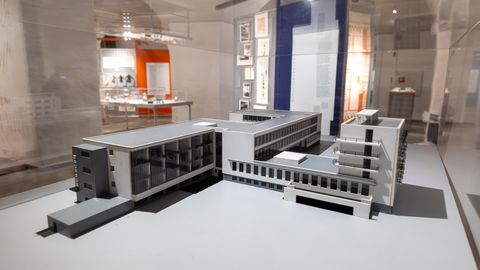
Bauhaus Taught the World to Think Differently – Now It Can Be Seen in Tallinn
Translated from Estonian, summarized and contextualized by DistantNews.
TLDR
- An exhibition titled 'The Whole World is Bauhaus' has opened at the Estonian Museum of Applied Art and Design in Tallinn.
- The exhibition explores the Bauhaus school's profound impact on modern design, architecture, and art education.
- Founded in 1919, the Bauhaus school, despite its short lifespan, significantly influenced global design trends, particularly in the US.
Tallinn is currently celebrating the enduring legacy of a revolutionary educational institution with the opening of the exhibition 'The Whole World is Bauhaus' at the Estonian Museum of Applied Art and Design. This exhibition is more than just a historical retrospective; it delves into the very essence of the Bauhaus movement, showcasing how its groundbreaking ideas continue to resonate and shape contemporary design, architecture, and art education worldwide.
Founded in Weimar in 1919 by Walter Gropius, the Bauhaus school was born from a visionary ambition to create a 'Gesamtkunstwerk' – a total work of art where all artistic disciplines converge. Though its existence was tragically cut short in 1933 by the Nazi regime, its influence proved immense. Many artists and designers who studied or taught at the school emigrated, particularly to the United States, carrying the Bauhaus philosophy with them and profoundly impacting the course of modern design.
From an Estonian perspective, appreciating the Bauhaus movement highlights the global interconnectedness of artistic innovation. It demonstrates how a relatively small school in Germany could fundamentally alter the visual language of the 20th century and beyond. The exhibition serves as a reminder that great ideas transcend borders and time, influencing creative fields in Estonia and across the globe. It encourages a deeper understanding of the principles that underpin modern aesthetics and functional design, principles that are still relevant for Estonian designers and architects today.
The exhibition's focus on the lasting impact of Bauhaus underscores its importance not just as a historical footnote, but as a living force in design thinking. It invites visitors to consider how these principles of simplicity, functionality, and the integration of art and industry continue to inform the objects and spaces we interact with daily. This is a crucial conversation for Estonia as it continues to develop its own design identity on the international stage.
DistantNews Editorial
Originally published by Postimees in Estonian. Translated, summarized, and contextualized by our editorial team with added local perspective. Read our editorial standards.
More Stories

/nginx/o/2026/04/21/17583844t1h87f6.jpg)

From Our Blog

What Gets Lost (and Found) When News Is Translated

The Critical Role of Diaspora Media in Global News

What Travellers Should Know About Countries with Restricted Press

A Digital Nomad's Guide to Following Local News

How the Same Story Looks Different in Different Countries
