


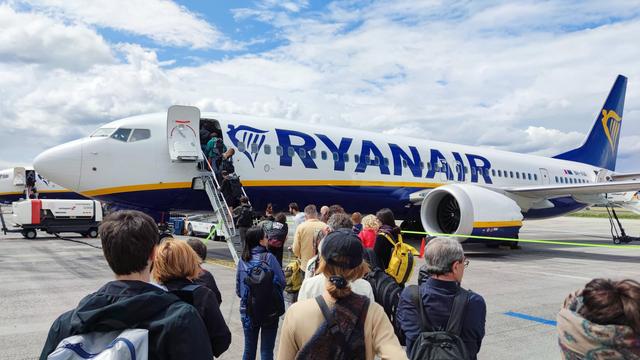
BER Airport: Aviation association expresses concern over Ryanair's withdrawal from Berlin
Translated from German, summarized and contextualized by DistantNews.
TLDR
- Ryanair plans to significantly reduce its operations at Berlin Brandenburg Airport (BER), halving its flights and closing its base.
- The airline blames the decision on planned fee increases by the airport, while the airport operator denies such hikes are scheduled.
- The German Aviation Association (ADV) warns this move signals a broader issue with Germany's competitiveness as an aviation hub due to high location costs.
Ryanair's announcement to drastically cut its services at Berlin Brandenburg Airport (BER) has sent shockwaves through the German aviation sector. The budget airline intends to halve its flight offerings for the winter schedule and close its BER base by October 24, withdrawing its seven stationed aircraft. This decision, according to Ryanair, is a direct response to the airport's communicated intention to increase fees by an additional ten percent between 2027 and 2029.
However, the airport operator, Flughafengesellschaft Berlin-Brandenburg (FBB), has refuted Ryanair's claims, stating that no such fee increase is planned and that negotiations regarding charges are ongoing. This discrepancy highlights a potential conflict between the airline's cost-saving strategies and the airport's financial planning. From the perspective of DIE ZEIT, a prominent German weekly newspaper, this dispute is not merely a bilateral issue but indicative of deeper structural problems facing German aviation.
The Arbeitsgemeinschaft Deutscher Verkehrsflughäfen (ADV), the German Airport Association, has voiced significant concern, characterizing Ryanair's move not as a decision against Berlin specifically, but against Germany as a whole. ADV chief executive Ralph Beisel pointed to "structural problems" and "high location costs" in Germany as the primary deterrents for airlines. These costs, he elaborated, encompass air traffic tax, security fees, and air navigation charges, which collectively make operating in Germany more expensive compared to other European countries.
ADV provided stark comparisons: a flight from Berlin to Palma incurs around €7,600 in taxes and fees, versus approximately €4,400 from Warsaw. Similarly, a flight to New York from a German airport costs about €25,300, compared to €13,900 from a comparable European hub. This data underscores Germany's struggle to maintain competitiveness, evidenced by minimal passenger growth over the past decade while neighboring countries have seen substantial increases. The Ryanair withdrawal from BER, therefore, serves as a critical warning about the broader implications for Germany's position in the global aviation market.
Germany is looking at BER Airport after Ryanair's announcement, but it is actually not a decision against Berlin, but against Germany as an air transport location overall.
DistantNews Editorial
Originally published by Die Zeit in German. Translated, summarized, and contextualized by our editorial team with added local perspective. Read our editorial standards.
More Stories



From Our Blog

What Gets Lost (and Found) When News Is Translated

How the Same Story Looks Different in Different Countries

The Critical Role of Diaspora Media in Global News

What Travellers Should Know About Countries with Restricted Press

A Digital Nomad's Guide to Following Local News
