

Breakthrough Research in Volhynia: Forensic Doctor to Examine How Poles Died in Wola Ostrowiecka
Translated from Polish, summarized and contextualized by DistantNews.
At a glance
News
From a news agency
Ongoing story
- Forensic specialists are conducting detailed examinations in Wola Ostrowiecka, Volhynia, to determine the cause of death for Polish residents murdered in 1943.
- The ongoing exhumation work, led by the Institute of National Remembrance (IPN), has uncovered remains of nearly forty individuals.
- Forensic doctor Łukasz Szleszkowski is applying standard procedures to analyze injuries, determine causes of death, and collect genetic material for identification.
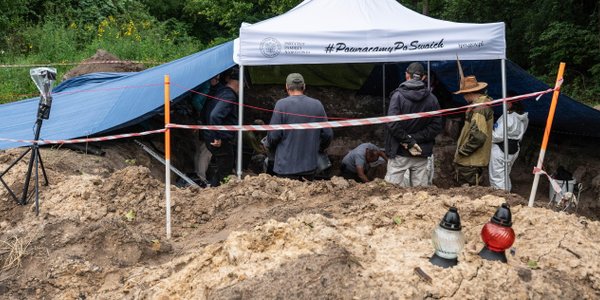
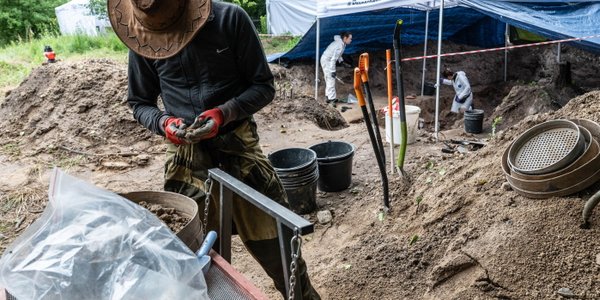
An interdisciplinary team, including forensic medicine specialists, archaeologists, and anthropologists, is conducting detailed exhumation work in Wola Ostrowiecka, Volhynia. The investigation aims to precisely determine how Polish residents, murdered by Ukrainian nationalists during the Volhynia massacre in August 1943, died. The Institute of National Remembrance (IPN) is leading the current exhumation efforts.
For eighteen years, I have been closely cooperating with the Institute of National Remembrance in this type of research and search. This is several stages of my work here with the remains. The first stage, where we are now, is the description, assistance in removing the remains from the mass grave. Description of the arrangement of the remains, photographic documentation, diagrams of the arrangement.
Dr. Łukasz Szleszkowski, a forensic medicine specialist from the Medical University of Wrocław, is part of the team. He explained that his work involves several stages, beginning with documenting the arrangement of remains in the mass grave. He applies the same rigorous procedures used in criminal investigations to describe the scene and assist in the recovery of the bodies.
"This is the first stage, where we are now. The second is the examination, which we conduct in the laboratory," Dr. Szleszkowski told PAP. He elaborated that the laboratory phase includes an anthropological part for individual identification, determining age, sex, and unique characteristics. His own medical-forensic role focuses on describing injuries, interpreting them, and establishing the most probable cause and type of death, as well as the circumstances surrounding the trauma.
This is the first stage, where we are now. The second is the examination, which we conduct in the laboratory. This laboratory will be set up in a different location. The examination will consist of two parts. The anthropological part concerns individual identification, i.e., all those preliminary identification studies concerning age, sex, individual identification characteristics. This is the anthropological part, and mine, as a forensic doctor, the medical-forensic part concerns the description of injuries. Description of injuries, interpretation of these injuries, determination of the most probable cause of death, the type (of injuries - PAP) that caused these tools and possibly the circumstances of these injuries. This is my role.
The final stage involves collecting material for genetic testing. The team will identify skeletal elements most likely to yield successful DNA results and secure them carefully to prevent contamination. This genetic analysis offers a chance for the IPN to potentially identify victims and provide answers to their families.
The third, final stage, is collecting material for genetic testing. That is, selecting those skeletal elements that best promise success in genetic testing, securing them properly. So as not to lead to contamination, i.e., contamination with other material, securing these samples.
DistantNews Editorial
Originally published by Rzeczpospolita in Polish. Translated, summarized, and contextualized by our editorial team with added local perspective. Read our editorial standards.
More Stories
From Our Blog

What Gets Lost (and Found) When News Is Translated

The Critical Role of Diaspora Media in Global News

What Travellers Should Know About Countries with Restricted Press

A Digital Nomad's Guide to Following Local News

How the Same Story Looks Different in Different Countries
