


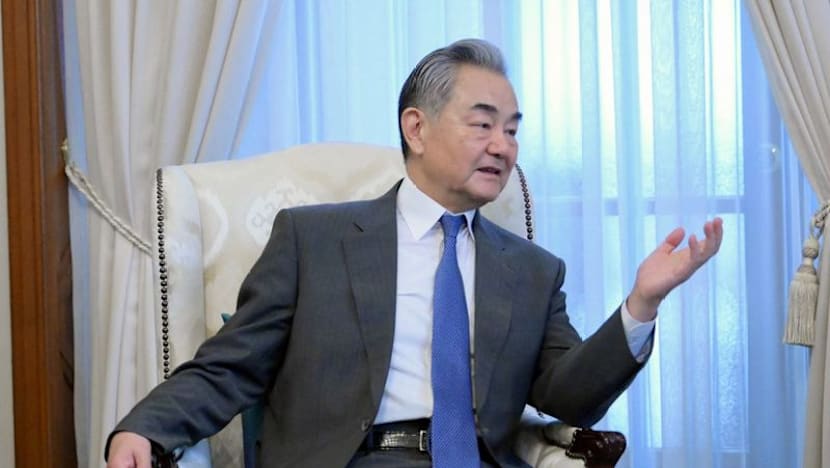
China urges US to preserve 'stability' in ties, warns Taiwan is 'risk point'
Summarized and contextualized by DistantNews.
TLDR
- China's foreign minister urged the US to safeguard the stability of bilateral relations ahead of President Trump's upcoming visit.
- Beijing views Taiwan as the biggest risk point in China-US relations and insists the US honor its commitments.
- The two sides also discussed the Middle East, with China playing a key role in its relationship with Tehran.
From Beijing's perspective, the call between Foreign Minister Wang Yi and US Secretary of State Marco Rubio underscores the delicate balance in China-US relations. While both sides acknowledge the need to "safeguard the hard-won stability," China's core message is clear: Taiwan remains the paramount issue. Wang Yi's explicit warning that Taiwan is the "biggest risk point" reflects Beijing's unwavering stance that the self-ruled island is an inalienable part of China. The emphasis on the US honoring its commitments is a direct reference to Washington's One China policy and a warning against any actions that could be perceived as supporting Taiwan's independence.
Both sides should safeguard the hard-won stability, prepare well for key high-level interactions, expand areas of cooperation and manage their differences.
This interaction, occurring just weeks before President Trump's visit, is a strategic move by China to set the agenda and manage expectations. Beijing aims to ensure that the US understands the gravity of the Taiwan issue and does not miscalculate its resolve. The mention of the Middle East, while seemingly a secondary topic, also carries weight. China's role as a partner to Tehran, contrasted with the US-Israel pressure on Iran, highlights the differing approaches and potential for friction in regional security matters. China's desire for global stability, as articulated by Wang Yi, is framed within its own national interests and its vision for a multipolar world.
The Taiwan issue concerns China's core interests and is the biggest risk point in China-US relations.
For Chinese observers, this exchange is a testament to China's growing diplomatic assertiveness. Unlike in the past, Beijing is not shying away from directly addressing contentious issues with the US. The framing of "hard-won stability" suggests that China perceives the current state of relations as fragile and requires careful management, with the US bearing significant responsibility. The focus on high-level interactions and expanding cooperation, while simultaneously drawing red lines on Taiwan, showcases China's dual approach: seeking pragmatic engagement while resolutely defending its core interests. This is a narrative that resonates strongly within China, emphasizing national sovereignty and the importance of international respect for its internal affairs.
The United States must honour its commitments and make the right choices, opening new perspectives for bilateral cooperation and do its part to promote world peace.
DistantNews Editorial
Originally published by CNA. Summarized and contextualized by our editorial team with added local perspective. Read our editorial standards.
More Stories


From Our Blog

What Gets Lost (and Found) When News Is Translated

The Critical Role of Diaspora Media in Global News

What Travellers Should Know About Countries with Restricted Press

A Digital Nomad's Guide to Following Local News

How the Same Story Looks Different in Different Countries
