


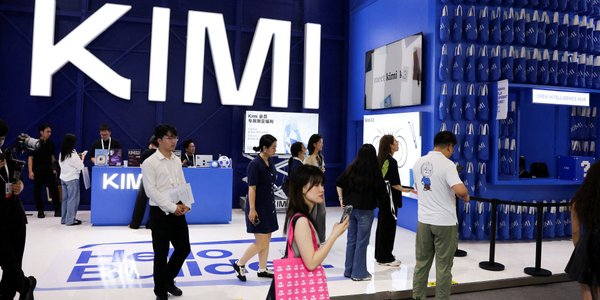
Chinese AI Kimi3 Sparks Market Panic, Rivals Western Giants
Translated from Polish, summarized and contextualized by DistantNews.
At a glance
News
Sources not specified
Ongoing story
- Chinese AI startup Moonshot has released its Kimi3 model, which rivals advanced models like OpenAI's GPT 5.6 Sol and Anthropic's Claude Fable 5 in some benchmarks.
- The free and open-source nature of Kimi3 has caused market turmoil, offering a low-cost alternative to expensive AI models and sparking fears among Western tech companies.
- U.S. officials are considering measures against Chinese AI firms developing open-source models due to national security concerns, with potential actions including trade blacklists and executive orders.
The emergence of Kimi3, an artificial intelligence model developed by Chinese startup Moonshot, has sent shockwaves through the global AI market, drawing comparisons to the geopolitical impact of the Soviet Union's Sputnik launch in 1957.
Kimi3 has demonstrated capabilities comparable to leading Western AI models, including OpenAI's GPT 5.6 Sol and Anthropic's Claude Fable 5, according to certain benchmarks. Crucially, Moonshot has released Kimi3 as a free and open-source model, allowing anyone to download and modify it for their specific needs. This move presents a significant challenge to the business models of high-cost AI developers and has triggered a sell-off in the stocks of American tech giants.
Concerns are mounting regarding the training data used by Moonshot. U.S. officials and Anthropic have accused the company of training its model on content generated by other AI models, a claim that Moonshot denies. The open-source nature of Kimi3 has also raised national security alarms in the United States.
One of the likely outcomes of a world dominated by open AI models is full AI-communism, which is exactly what China proposes: instead of a market product, AI should be a 'public good' that will ultimately be delivered by the state as a kind of 'public digital infrastructure'.
According to The Wall Street Journal, U.S. security officials have been discussing various measures to tighten policies on Chinese companies developing open-source AI models. These considerations reportedly include adding such firms to trade blacklists, issuing security warnings, and potentially enacting an executive order targeting open-source models. However, internal disagreements within the U.S. administration have so far prevented the implementation of these actions.
OpenAI's Dean Ball has voiced concerns that a world dominated by open-source AI models could lead to "full AI-communism," where AI becomes a "public good" provided by the state, mirroring China's approach. Anthropic CEO Dario Amodei has also repeatedly warned about the risks associated with powerful, freely available AI systems, particularly those with advanced cybersecurity capabilities, calling it a "serious concern."
This is a serious concern.
DistantNews Editorial
Originally published by Rzeczpospolita in Polish. Translated, summarized, and contextualized by our editorial team with added local perspective. Read our editorial standards.
More Stories



From Our Blog

What Gets Lost (and Found) When News Is Translated

The Critical Role of Diaspora Media in Global News

What Travellers Should Know About Countries with Restricted Press

A Digital Nomad's Guide to Following Local News

How the Same Story Looks Different in Different Countries
