


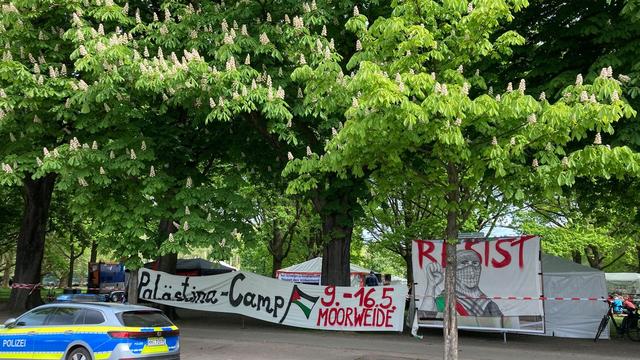
Demonstration: Palestine Camp on Hamburg's Moorweide - Police Observe
Translated from German, summarized and contextualized by DistantNews.
TLDR
- Hamburg police are monitoring an anti-Israeli protest camp set up on the Moorweide after activists successfully challenged a ban in administrative court.
- The camp, organized by groups including Thawra Hamburg (monitored by the domestic intelligence agency), is scheduled to host events until May 16th.
- Organizers state their goals include protesting arms deliveries and German complicity, while the court ruled that the camp falls under freedom of assembly rights, despite concerns about the organizers' extremist leanings.
In Hamburg, a contentious anti-Israeli protest camp, dubbed 'Bridges of Resistance,' has been established on the Moorweide, a site with historical significance due to its past as a gathering point for Jewish deportations during the Holocaust. Activists, including those from the group Thawra Hamburg which is monitored by the domestic intelligence agency for extremist tendencies, successfully challenged the authorities' ban on the camp at the administrative court. This ruling underscores a complex legal battle between public order concerns and the fundamental right to freedom of assembly.
Mit dem Camp verbinden wir Kämpfe gegen Waffenlieferungen, Militarisierung und totalitären Staatsumbau. Zusammen bauen wir Druck gegen Genozid, Besatzung und die deutsche Komplizenschaft auf.
The camp is slated to host a series of events until May 16th, drawing participation from trade union and party representatives. The organizers have articulated their aims, stating they connect struggles against arms deliveries, militarization, and "totalitarian state restructuring," while also building pressure against "genocide, occupation, and German complicity." These declarations, particularly the reference to "genocide," are highly charged and have understandably raised concerns, especially given the historical context of the Moorweide.
Es lebe der revolutionäre Kampf in Palästina
From our vantage point at Die Zeit, this situation presents a critical examination of Germany's commitment to free speech and assembly, even when the message is controversial or associated with groups deemed extremist. The administrative court's decision, emphasizing that general extremist leanings are legally irrelevant unless manifested in concrete actions threatening legal interests, highlights a legal principle that often clashes with public sentiment. While international coverage might focus on the protest's anti-Israeli stance, we are compelled to analyze the legal framework that permits such demonstrations and the societal implications of balancing security concerns with civil liberties. The organizers' explicit statements disavowing the questioning of Israel's right to exist or the relativization of the Holocaust, despite their affiliations, add another layer to this intricate debate.
Eine allgemeine radikale oder extremistische Grundeinstellung des Veranstalters oder Leiters ist für die Gefahrenprognose rechtlich irrelevant, solange sie sich nicht in konkreten, auf die Versammlung bezogenen rechtsgutgefährdenden Aktionen manifestiert.
DistantNews Editorial
Originally published by Die Zeit in German. Translated, summarized, and contextualized by our editorial team with added local perspective. Read our editorial standards.
More Stories



From Our Blog

What Gets Lost (and Found) When News Is Translated

How the Same Story Looks Different in Different Countries

The Critical Role of Diaspora Media in Global News

What Travellers Should Know About Countries with Restricted Press

A Digital Nomad's Guide to Following Local News
