


Discovery of DNA 'Repetitive Sequence' Inducing Herpes Virus Immune Response
Translated from Korean, summarized and contextualized by DistantNews.
TLDR
- Researchers have identified a specific DNA repetitive sequence, 'poly(T)', in the herpes simplex virus that triggers an immune response.
- This discovery explains why inflammation occurs around the lips during herpes outbreaks, as the host's immune sensor (AIM2) recognizes this sequence.
- The findings, published in Nature Communications, offer a potential basis for developing personalized immunomodulatory drugs to treat viral infections.
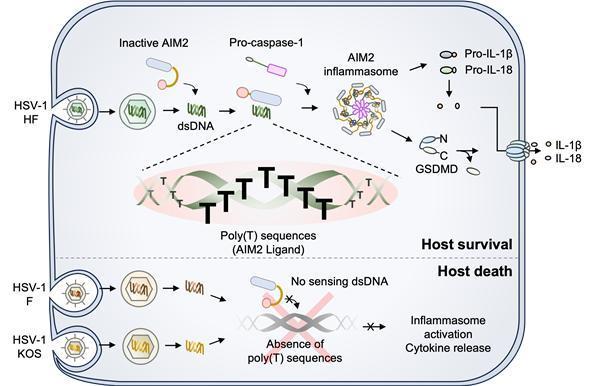
A groundbreaking study by Professor Lee Sang-jun's team at UNIST has illuminated the intricate mechanism by which the human immune system detects herpes simplex virus (HSV) DNA. Published in Nature Communications, the research pinpoints a repetitive sequence of thymine bases, known as 'poly(T)', within the viral DNA as the key trigger for activating the host's innate immune sensors, specifically the AIM2 inflammasome in macrophages.
This finding provides a crucial explanation for the inflammatory responses observed during herpes outbreaks. The study demonstrates that the presence and length of the poly(T) sequence directly correlate with the intensity of the immune reaction, leading to inflammation and the death of infected cells. Experiments showed that introducing this sequence into other viral strains could induce an immune response, while its removal rendered the virus less detectable by the immune system, allowing for rapid proliferation.
Professor Lee highlighted the significance of this discovery for future therapeutic strategies. Instead of directly targeting the virus, which can be challenging due to its ability to hide in nerve cells, this research opens avenues for developing drugs that modulate the host's immune sensors. The team also found that similar repetitive sequences are conserved across various virus families, suggesting broad applicability for this approach in combating a range of infectious diseases. This work, a collaboration involving multiple South Korean institutions, represents a significant step towards developing novel, personalized immunotherapies.
The discovery provides a theoretical foundation for the development of personalized immunomodulatory drugs.
DistantNews Editorial
Originally published by Dong-A Ilbo in Korean. Translated, summarized, and contextualized by our editorial team with added local perspective. Read our editorial standards.
More Stories



From Our Blog

What Gets Lost (and Found) When News Is Translated

The Critical Role of Diaspora Media in Global News

What Travellers Should Know About Countries with Restricted Press

A Digital Nomad's Guide to Following Local News

How the Same Story Looks Different in Different Countries
