


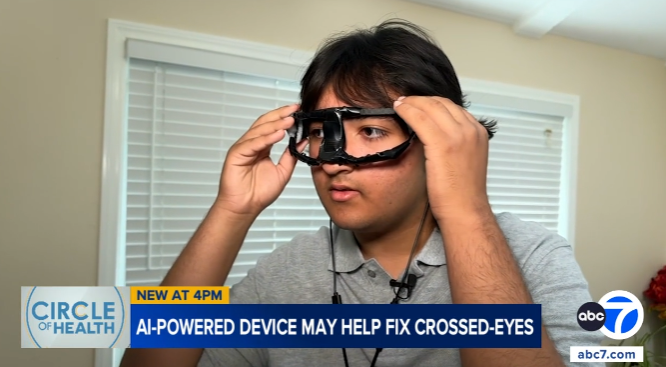
US Teen Develops AI Device to Correct Crossed Eyes
Translated from Korean, summarized and contextualized by DistantNews.
TLDR
- A 14-year-old American boy named Arian Valaani has developed an AI-powered wearable device to help correct strabismus (crossed eyes).
- The device, called EYEVA, uses a small camera and AI algorithms to detect eye misalignment and alerts the user.
- Valaani, who developed the device after experiencing strabismus himself, aims to get FDA approval after clinical trials.
In a remarkable display of youthful ingenuity and personal resilience, 14-year-old Arian Valaani from Cerritos, California, has developed an innovative AI-powered wearable device to assist individuals with strabismus. His creation, named EYEVA, stems from his own experience with the condition, which he developed after a fall at age five resulted in a concussion. This personal connection imbues his technological achievement with a profound sense of purpose.
People used to say, 'Your eyes are broken,' and I had to fight not only vision problems but also social prejudice.
Valaani's journey is a testament to the power of applying technology to solve real-world problems, particularly those that impact quality of life and social interaction. Strabismus, often colloquially referred to as "crossed eyes," not only affects vision but can also lead to social stigma, as Valaani himself experienced when people commented on his "broken eyes." His motivation to create a device that helps users become more aware of their eye alignment is deeply rooted in overcoming these challenges.
When the signal sounds, I realize, 'Ah, I need to pay attention to my face now.'
The EYEVA device itself is a sophisticated yet accessible piece of technology. Utilizing a small camera and AI algorithms, it monitors eye movements in real-time. When misalignment is detected, it emits an audible alert, prompting the user to consciously correct their gaze. This feedback mechanism is crucial for retraining the brain and improving eye coordination. Valaani's previous success in developing an AI system to detect litter on roads demonstrates a consistent aptitude for leveraging AI in practical applications.
Arian's project is an excellent example of the integration of science, engineering, and computing.
Having already won top honors at the Orange County Science and Engineering Fair, EYEVA has garnered significant recognition for its practicality and innovation. Valaani's ambition extends beyond this initial success; he is currently collaborating with medical professionals and pursuing a patent, with the ultimate goal of FDA approval. His message to aspiring young innovators – "Start as soon as you have an idea" – resonates with the spirit of discovery and perseverance that defines his own remarkable achievement. This story highlights not just a technological breakthrough but also the potential of young minds to create meaningful change.
As soon as you have an idea, start it. If it's a feasible idea, pursue it as much as you can.
DistantNews Editorial
Originally published by Dong-A Ilbo in Korean. Translated, summarized, and contextualized by our editorial team with added local perspective. Read our editorial standards.
More Stories



From Our Blog

What Gets Lost (and Found) When News Is Translated

The Critical Role of Diaspora Media in Global News

What Travellers Should Know About Countries with Restricted Press

A Digital Nomad's Guide to Following Local News

How the Same Story Looks Different in Different Countries
