

Etna Eruption Causes 20-Year Air Traffic Crisis in Catania; Tourists Flock to Volcano Despite Warnings
Translated from Polish, summarized and contextualized by DistantNews.
At a glance
News
Sources not specified
Ongoing story
- Mount Etna's prolonged eruption has caused the most severe air traffic crisis in Catania in 20 years, halting flights until Saturday.
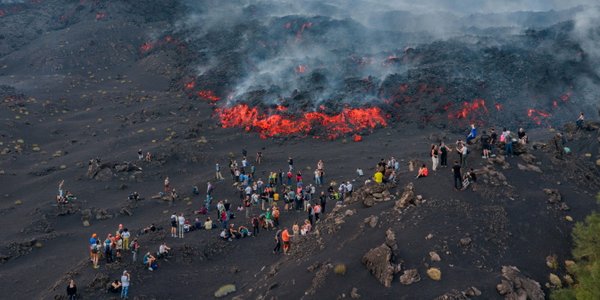
- Hundreds of tourists are flocking to the volcano despite warnings, drawn by the spectacle of lava and ash.
- Experts urge caution, highlighting the dangers of unstable slopes and toxic gases, reminding visitors that "an active volcano is not a viewing terrace."
Mount Etna's ongoing eruption, characterized by seven days of continuous lava and ash emissions, has triggered a major air traffic crisis at Catania Airport, the most severe in two decades. Flight arrivals and departures are suspended until Saturday morning, with passengers being rerouted to other airports.
The arrivals and departures are suspended until Saturday at 2 AM according to the latest announcements.
Simultaneously, the volcanic activity has ignited immense public interest, drawing hundreds of tourists daily to the slopes of Europe's most active volcano. Despite official safety measures and expert appeals for caution, many visitors are seen disregarding warnings, approaching dangerously close to flowing lava and ignoring the risks associated with unstable terrain and toxic gases.
Volcanologists describe Etna's current eruptive phase as unprecedented in its duration, contrasting sharply with the typically short, violent episodes observed in recent decades. Salvo Gambino, director of the Etna Observatory at the National Institute of Geophysics and Volcanology, noted that such sustained activity, involving explosions, lava fountains, and dense ash clouds, has not been seen since the late 1970s. He suggests that magma emerging from greater depths, rich in gases, might be the cause of this anomaly.
An active volcano is not a viewing terrace: unstable slopes, fragile ground, sudden deterioration of visibility, gullies, and accumulation of harmful gases pose a real threat.
While the multi-front activity allows for energy release, potentially limiting lava flows to higher altitudes, it also generates a continuous expulsion of fine pyroclastic materials. The Sicilian daily "La Sicilia" emphasized the allure of the glowing lava flows at night, which attracts thousands seeking the perfect photograph. However, the newspaper, quoting scientists, stressed the inherent dangers: "Etna is not a viewing terrace: unstable slopes, fragile ground, sudden deterioration of visibility, gullies, and accumulation of harmful gases pose a real threat."
To find an equally long sequence of activity, one must go back to the end of the 1970s. Such long activity constitutes an anomaly compared to recent decades, which were characterized by violent but short eruptive episodes.
The Sicilian Civil Protection Department had raised the alert level from green to yellow on June 26 due to increased volcanic tremors and renewed activity. Experts like Gambino continue to urge extreme caution, advising observation of the volcano solely from safe and permitted areas.
The scientific key to this exceptional duration of the phenomenon may be the emergence of magma from greater depths, particularly rich in gases.
DistantNews Editorial
Originally published by Rzeczpospolita in Polish. Translated, summarized, and contextualized by our editorial team with added local perspective. Read our editorial standards.
More Stories
From Our Blog

What Gets Lost (and Found) When News Is Translated

The Critical Role of Diaspora Media in Global News

What Travellers Should Know About Countries with Restricted Press

A Digital Nomad's Guide to Following Local News

How the Same Story Looks Different in Different Countries
