


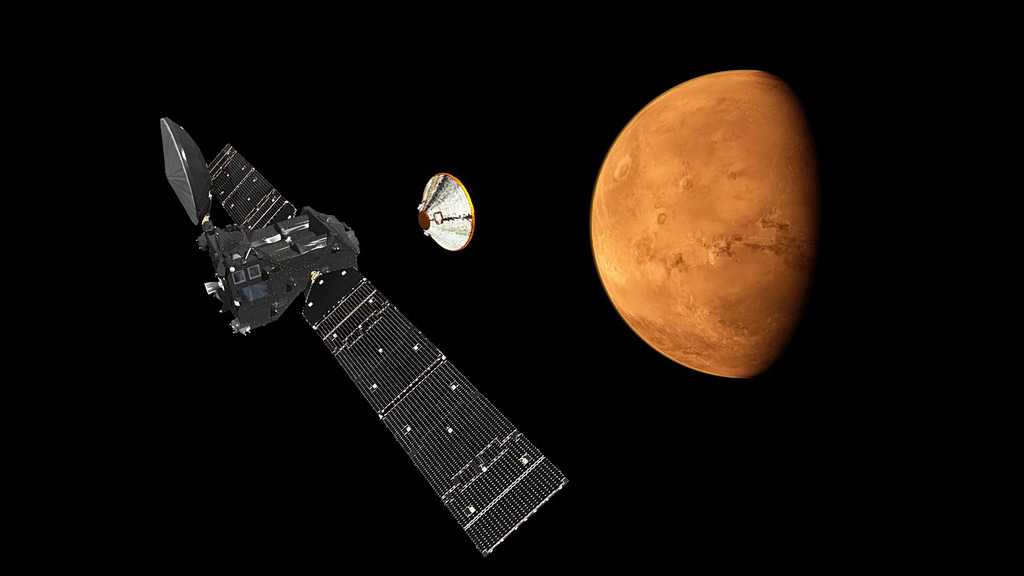
Fungus from NASA labs 'survived' Mars travel simulation
Translated from Greek, summarized and contextualized by DistantNews.
TLDR
- A fungus discovered in NASA's clean rooms has proven capable of surviving simulated Mars journey conditions and the planet's surface.
- The study, published in Applied and Environmental Microbiology, raises concerns about preventing Earth's biology from contaminating other worlds.
- Researchers found the fungus, Aspergillus calidoustus, particularly resilient when exposed to extreme cold and radiation simultaneously.
A groundbreaking study originating from Greece, published in the esteemed journal Applied and Environmental Microbiology, reveals a startling discovery: a fungus found in NASA's own clean rooms possesses an extraordinary resilience, capable of surviving the harsh conditions of a simulated journey to Mars and even the planet's surface. This finding, spearheaded by microbiologist Kasturi Venkateswaran, formerly of NASA's Jet Propulsion Laboratory, casts a critical light on our current planetary protection protocols.
This study is the first to demonstrate that a eukaryotic microbial organism—a complex organism with a nucleus—could survive every phase of a Mars mission: from pre-launch preparation and space travel, to robotic exploration on the surface.
The fungus, identified as Aspergillus calidoustus, was isolated from the assembly facilities used for the Mars 2020 mission. Its ability to persist despite stringent sterilization procedures is remarkable. Researchers subjected its spores to simulated space and Martian conditions, including UV and ionizing radiation, near-vacuum atmospheric pressure, polar temperatures, and Martian soil. Astonishingly, the spores survived, underscoring the tenacious nature of microbial life and posing significant questions for future space exploration.
This research is particularly significant from a Greek and European perspective, as it directly impacts the ongoing discourse about space exploration and the ethical considerations involved. While Western media often focuses on the technological marvels of space missions, Greek scientific publications like Ta Nea emphasize the critical scientific questions and potential risks. The study highlights that current planetary protection strategies, which have historically focused on bacteria, may be insufficient, as this fungus proved exceptionally resistant, especially when exposed to a combination of extreme cold and high radiation.
This does not mean that Mars contamination is certain, but it helps to better determine the risks, noting the exceptional resilience of microorganisms.
The implications of this discovery are profound. It suggests that our understanding of microbial survival in extraterrestrial environments is incomplete and necessitates a re-evaluation of sterilization methods. As Greece, like many European nations, engages with the global space community, this research provides crucial data for developing more robust strategies to prevent the unintentional transfer of terrestrial life to other celestial bodies, ensuring the integrity of scientific research and the potential for discovering native extraterrestrial life.
The finding reveals a gap in current planetary protection strategies, which have historically focused on resilient bacteria and not fungi.
DistantNews Editorial
Originally published by Ta Nea in Greek. Translated, summarized, and contextualized by our editorial team with added local perspective. Read our editorial standards.
More Stories
From Our Blog

What Gets Lost (and Found) When News Is Translated

The Critical Role of Diaspora Media in Global News

What Travellers Should Know About Countries with Restricted Press

A Digital Nomad's Guide to Following Local News

How the Same Story Looks Different in Different Countries
