


Gdańsk Port completes first phase of strategic grain terminal, boosting Polish exports and food security
Translated from Polish, summarized and contextualized by DistantNews.
At a glance
News
Named sources
New plan
- The first phase of the Grain and Agri Terminal (GAT) at the Port of Gdańsk has been completed, enhancing Poland's export potential and food security.
- The new terminal significantly increases the port's transshipment and storage capacity for agricultural and food products.
- The project, entirely Polish-funded and executed, is a strategic investment with a second phase planned until 2029.
The Port of Gdańsk has completed the first phase of its new Grain and Agri Terminal (GAT), a strategic investment designed to boost Poland's export capabilities and bolster national food security. This development significantly expands the port's capacity for handling and storing agricultural and food products, responding to growing market demands.
The GAT project, executed by Port Gdański Eksploatacja SA, a subsidiary of the Port of Gdańsk Authority, is highlighted as a 100% Polish initiative. "We are launching another strategic investment that will not only increase Poland's export potential but, above all, strengthen our food security," stated Arkadiusz Marchewka, Deputy Minister of Infrastructure. He emphasized that modern ports are crucial for economic, energy, military, and food security, areas where record investments are now being made.
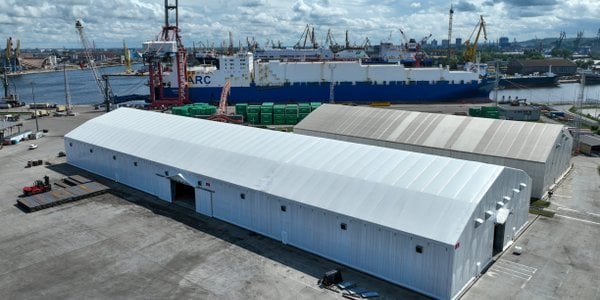
The initial phase involved constructing a flat warehouse on Szczeciński Quay, covering nearly 6,500 square meters with a volume of over 93,000 cubic meters. This facility can store 30,000 tons of cargo and has a transshipment capacity of 0.5 million tons annually, capable of handling up to 120 vehicles daily with a throughput of 8,000 tons per day. The warehouse features a modern, single-nave steel structure with a span of nearly 50 meters without internal columns, allowing for efficient use of space and smoother cargo handling. Its flexible design permits division into two or three independent storage zones.
The second phase of the GAT project is slated for completion by 2029. It will include the construction of 24 flat-bottom silos on Wiślany Quay, integrated with a highly automated transshipment system. This expansion aims to further enhance the terminal's throughput and operational efficiency, solidifying the Port of Gdańsk's role as a key logistical hub for Polish agricultural exports.
We are launching another strategic investment that will not only increase Poland's export potential but, above all, strengthen our food security. Modern ports are not only about economy or energy, but also military and food security – and it is precisely in these areas that we are investing record funds today. What is particularly important is that this is a 100% Polish terminal, realized by Port Gdański Eksploatacja, belonging to the Port of Gdańsk Authority, and thus to the State Treasury.
DistantNews Editorial
Originally published by Rzeczpospolita in Polish. Translated, summarized, and contextualized by our editorial team with added local perspective. Read our editorial standards.
More Stories

From Our Blog

What Gets Lost (and Found) When News Is Translated

The Critical Role of Diaspora Media in Global News

What Travellers Should Know About Countries with Restricted Press

A Digital Nomad's Guide to Following Local News

How the Same Story Looks Different in Different Countries
