

Geopolitical Conflicts Force Rapid Reshaping of Global Maritime Routes
Translated from Romanian, summarized and contextualized by DistantNews.
TLDR
- Global maritime routes are rapidly reconfiguring due to geopolitical conflicts, particularly blockades in the Strait of Hormuz and Red Sea attacks, impacting over 80% of world trade.
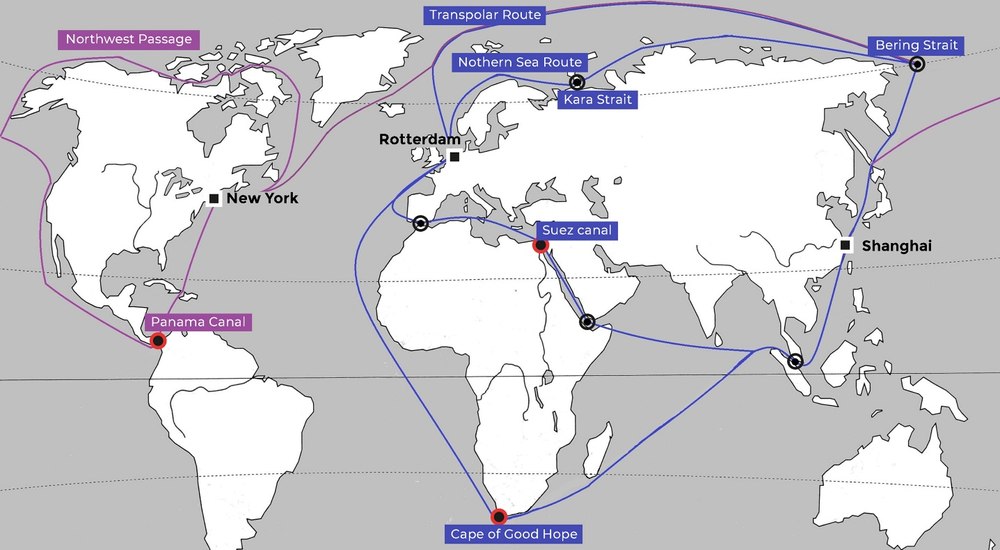
- Arctic routes are emerging as a potential alternative, offering shorter distances, but their economic viability remains limited for at least five years, primarily for bulk cargo transport.
- While Arctic routes show cost reductions for liquid and dry bulk commodities, containerized shipping remains uncompetitive due to operational constraints and vessel size limitations.
The world's shipping lanes, the arteries of global commerce, are undergoing a seismic shift. As highlighted by Coface's analysis, the escalating geopolitical tensions in critical chokepoints like the Strait of Hormuz and the persistent attacks disrupting traffic in the Red Sea are no longer mere inconveniences; they are forcing a fundamental reshaping of maritime trade.
Blocajele din Strâmtoarea Ormuz și atacurile care destabilizează traficul din Marea Roșie forțează o reconfigurare rapidă a rutelor maritime globale, expunând fragilitatea unui sistem prin care circulă peste 80% din comerțul mondial.
This fragility is starkly exposed when considering that over 80% of global trade relies on these sea routes. The concentration of this trade among a few key corridors makes the entire system vulnerable to shocks. While Western media often focuses on the immediate disruptions to supply chains and consumer prices, the deeper implication is the strategic redrawing of global trade maps.
Pe măsură ce coridoarele tradiționale devin tot mai riscante, atenția se mută spre alternative precum rutele arctice — mai scurte, dar încă limitate — într-o lume în care geopolitica începe să redeseneze harta transportului global.
In this evolving landscape, the Arctic routes present a tantalizing prospect. Accelerated by climate change, these northern passages offer significantly shorter transit times between major economic hubs like East Asia and Europe. However, as the report details, the promise of these routes is tempered by practical realities. For the next five years, at least, their economic competitiveness is largely confined to the transport of raw materials – crude oil, diesel, LNG, and certain dry bulk goods. The dream of a fully-fledged Arctic shipping superhighway for all types of cargo, especially containerized goods, remains distant.
Transportul maritim reprezintă peste 80% din comerțul mondial, fiind concentrat între trei regiuni majore – Asia de Est, Europa și America de Nord – și structurat în jurul unui număr limitat de coridoare strategice.
From our perspective in Romania, this reconfiguration is not just an abstract economic phenomenon. It underscores the interconnectedness of global security and trade. The instability in the Red Sea and the Persian Gulf directly impacts European economies, necessitating a keen understanding of these shifts. The potential of the Arctic, while promising, also raises complex environmental and geopolitical questions that require careful consideration, far beyond the immediate logistical calculations.
Potrivit unui studiu realizat de Coface, aceste rute beneficiază de deschiderea progresivă generată de schimbările climatice, însă potențialul lor comercial rămâne limitat pe termen de cel puțin cinci ani.
DistantNews Editorial
Originally published by Adevărul in Romanian. Translated, summarized, and contextualized by our editorial team with added local perspective. Read our editorial standards.
More Stories


From Our Blog

What Gets Lost (and Found) When News Is Translated

The Critical Role of Diaspora Media in Global News

What Travellers Should Know About Countries with Restricted Press

A Digital Nomad's Guide to Following Local News

How the Same Story Looks Different in Different Countries
