

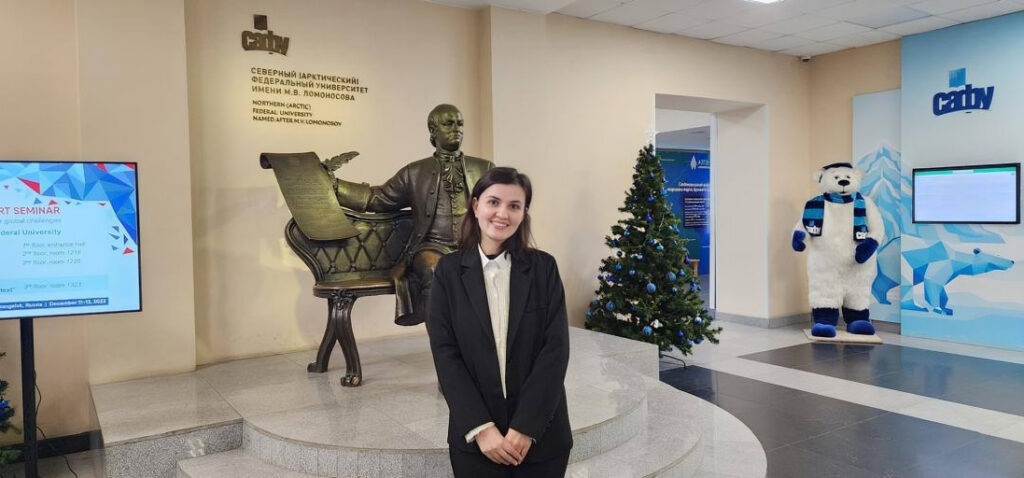
How Linguistic Background Helps Nigina Alifbekova Build an International Career
Translated from English, summarized and contextualized by DistantNews.
TLDR
- Nigina Alifbekova leverages her fluency in four languages to build an international career spanning Tajikistan, Kyrgyzstan, the USA, China, and the Arctic.
- She believes different languages activate distinct cognitive processes, influencing decision-making logic, speed, and focus.
- Alifbekova's expertise in linguistics aids her in business analytics and international negotiations by enabling her to understand subtext and cultural nuances.
In a world increasingly interconnected yet often fraught with misunderstanding, the story of Nigina Alifbekova, as told to Asia-Plus, offers a compelling narrative of how linguistic mastery transcends mere communication to become a powerful tool for international success.
Russian language: a mode of deep analysis and logical weighing of all “pros” and “cons” is activated. English language: thinking becomes faster, focused on the “big picture” and finding quick solutions. Chinese language: here, the focus shifts to the context of the situation and maintaining harmony in interpersonal relationships. Persian language: intuition awakens, with an emphasis on cultural nuances and emotional connections.
Alifbekova's journey, which has taken her from Tajikistan to the USA, China, and even the Arctic, is a testament to the value of multilingualism. Her assertion that different languages act as distinct "operating systems" for the brain—activating specific modes of analysis, speed, and focus—resonates deeply within our region. This perspective challenges the common view of language as simply a tool, highlighting its profound impact on cognitive processes and decision-making.
From our vantage point at [Publication Name], Alifbekova's insights into how Russian fosters deep analysis, English promotes quick solutions, Chinese emphasizes context and harmony, and Persian awakens intuition are particularly relevant. This nuanced understanding is crucial in navigating the complex diplomatic and business landscapes of Central Asia and beyond. Her ability to "read between the lines," honed through linguistic study, is invaluable in negotiations, especially in fields like Arctic science and technology diplomacy, as demonstrated by her work on a Russian-Chinese expert seminar.
Studying hieroglyphs requires extreme attentiveness: one small element can completely change the meaning of a word. This habit, she says, trains accuracy, the ability to break down information into parts, and to seek non-obvious connections.
What makes Alifbekova's story uniquely compelling from our perspective is its illustration of how human context and cultural understanding remain paramount, even in the age of artificial intelligence. Her comparison of studying Chinese hieroglyphs to business analytics—requiring extreme attentiveness to detail and the ability to discern subtle shifts in meaning—provides a powerful metaphor for the skills needed in today's globalized economy. This isn't just about translation; it's about building bridges of understanding across diverse cultures and perspectives, a skill that is increasingly vital for regional stability and prosperity.
pauses and repetitions often signal hidden doubts of a partner – it is very important to choose words correctly. When a client says “fine,” it does not always mean “suitable.” – cultural codes also play a significant role. For example, the polite “we’ll think about it” often means refusal.
DistantNews Editorial
Originally published by Asia-Plus in English. Translated, summarized, and contextualized by our editorial team with added local perspective. Read our editorial standards.
More Stories
From Our Blog

What Gets Lost (and Found) When News Is Translated

The Critical Role of Diaspora Media in Global News

What Travellers Should Know About Countries with Restricted Press

A Digital Nomad's Guide to Following Local News

How the Same Story Looks Different in Different Countries
