


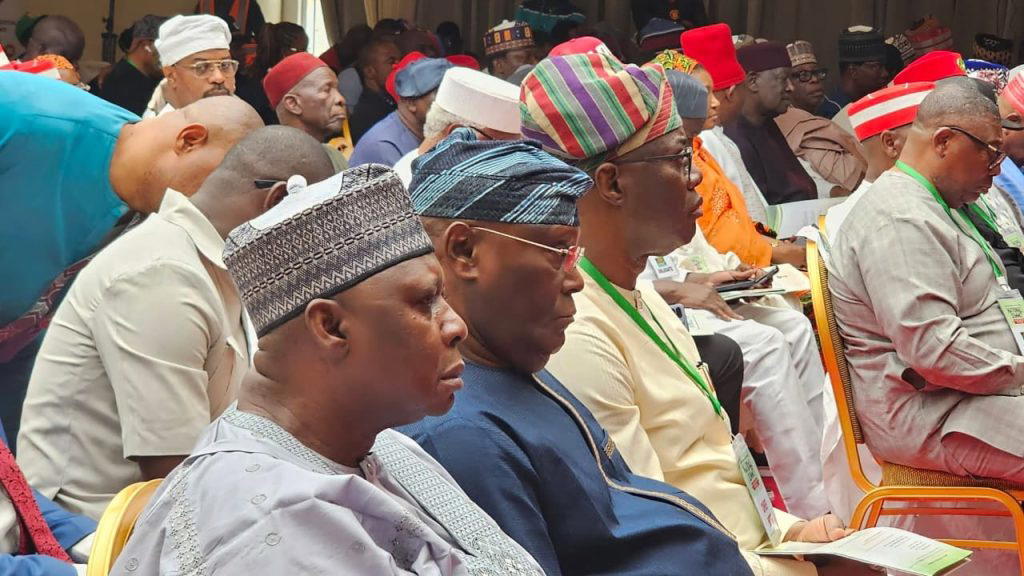
Ibadan Summit: Makinde Warns Against One-Party Rule, Cites 'Operation Wetie' History
Translated from English, summarized and contextualized by DistantNews.
TLDR
- Governor Seyi Makinde of Oyo State warned against one-party domination at a summit of opposition leaders in Ibadan, referencing the historical "Operation Wetie" violence.
- Makinde cautioned that democracy weakens when opposition becomes ineffective and alternatives disappear.
- Political economist Pat Utomi highlighted the country's severe economic hardship, citing personal experience with fuel costs and rising food prices amid widespread poverty.
At a pivotal national summit of opposition political party leaders held in Ibadan, Governor Seyi Makinde of Oyo State issued a stark warning against the dangers of one-party domination, drawing a chilling parallel to the "Operation Wetie" violence that plagued the South-West in the mid-1960s. The summit, which convened prominent opposition figures including Atiku Abubakar, Rabiu Musa Kwankwaso, Rotimi Amaechi, and Peter Obi, served as a platform for discussing the nation's political future and the challenges facing democracy.
For those that are carrying on as if there’s no tomorrow, they should remember that “operation wetie” started from here. This is the same Wild Wild West.
Makinde's reference to "Operation Wetie," a brutal form of political retribution involving the petrol-bombing of opponents and their property following the disputed 1965 western region elections, underscored his concern about the current political climate. He cautioned that the "Wild Wild West" mentality, which fueled such violence, could resurface if efforts to consolidate power under a single party are not checked. He emphasized that democracy thrives not on the success of one party, but on the existence of genuine alternatives and the ability of citizens to choose, lamenting the current state where opposition parties are often mired in internal crises and legal battles, diminishing their effectiveness.
Democracy is not destroyed overnight, it is weakened step by step until people begin to feel it no longer works for them.
Adding a critical layer to the summit's discourse, political economist and strategist Pat Utomi painted a grim picture of Nigeria's economic distress. He shared a personal anecdote of spending nearly 250,000 naira to fill his car's fuel tank, juxtaposing it with a report indicating a significant portion of Nigerians live on less than 100,000 naira per month. Utomi described this disparity as "absurd" and indicative of a "fundamentally broken" system. He further highlighted the compounding crises of rising food prices and insecurity disrupting agriculture, leaving ordinary citizens struggling to survive while being advised to 'be patient.'
Democracy is not defined by the success of one party, it is defined by the existence of real alternatives. By the ability of citizens to choose.
This summit, held in Ibadan, a city with a rich history of shaping Nigeria's constitutional future, carries a profound responsibility. The discussions highlighted not only the political imperative of maintaining a robust opposition but also the urgent economic realities that demand attention. The contrast between the political rhetoric and the lived experiences of economic hardship, as articulated by Utomi, underscores the complex challenges Nigeria faces. From a Nigerian perspective, the international media often focuses on the political theatrics, sometimes missing the deep-seated economic anxieties that fuel public sentiment and political instability. This summit, therefore, was not just about political strategy but about addressing the fundamental needs of the populace.
Let me begin with a simple experience from yesterday. I set out to buy fuel, and by the time I was done, I had spent nearly 250,000 naira just to fill my tank.
DistantNews Editorial
Originally published by Vanguard in English. Translated, summarized, and contextualized by our editorial team with added local perspective. Read our editorial standards.
More Stories


From Our Blog

How the Same Story Looks Different in Different Countries

What Gets Lost (and Found) When News Is Translated

The Critical Role of Diaspora Media in Global News

What Travellers Should Know About Countries with Restricted Press

A Digital Nomad's Guide to Following Local News
