


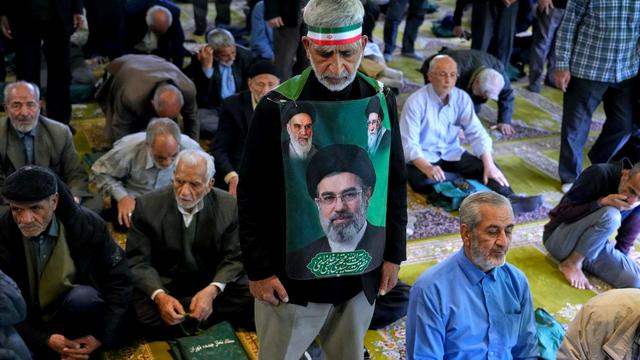
Iranian Regime: How Divided is Iran's Leadership?
Translated from German, summarized and contextualized by DistantNews.
TLDR
- Supporters of Iranian politician Said Jalili protested outside the Tasnim news agency, accusing the Revolutionary Guard of betrayal.
- This incident highlights internal divisions within Iran's leadership, particularly between hardline factions.
- The protests occurred shortly after a fragile ceasefire was announced, revealing that the regime is not as unified as it might appear.
The recent protests by supporters of Said Jalili outside the Tasnim news agency, an outlet close to the Revolutionary Guard, underscore the deep fissures within Iran's ruling elite. Accusations of betrayal leveled against the Guard by Jalili's faction reveal a stark power struggle playing out in the open.
This public display of internal conflict is particularly noteworthy given the prior perception that Iran's political landscape had become entirely monolithic. With moderate President Masoud Pezeshkian increasingly isolated and the new Supreme Leader Mojtaba Khamenei seen as even more hardline than his father, the assumption was that the system had achieved complete Gleichschaltung. However, this incident demonstrates that beneath the surface of enforced conformity, significant dissent and rivalry persist.
The timing of these protests, emerging shortly after the announcement of a fragile ceasefire, is significant. It suggests that the regime's internal dynamics are volatile and that external events can quickly expose these underlying tensions. The article, from the respected German publication Die Zeit, implies that the apparent unity of the Islamic Republic is far more brittle than previously assumed.
From an Iranian perspective, these internal power struggles are not merely abstract political maneuvering; they have direct implications for the country's stability and future direction. The infighting among hardline factions, while perhaps appearing chaotic to outside observers, reflects a desperate scramble for influence and control in a system that has systematically eliminated all moderate and reformist voices. This internal strife is a testament to the inherent instability of a regime that relies on suppression rather than genuine consensus.
DistantNews Editorial
Originally published by Die Zeit in German. Translated, summarized, and contextualized by our editorial team with added local perspective. Read our editorial standards.
More Stories

From Our Blog

What Gets Lost (and Found) When News Is Translated

How the Same Story Looks Different in Different Countries

The Critical Role of Diaspora Media in Global News

What Travellers Should Know About Countries with Restricted Press

A Digital Nomad's Guide to Following Local News
