

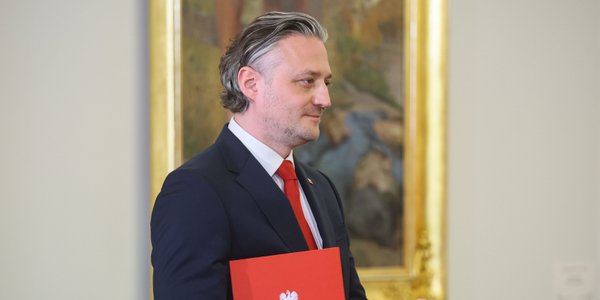
Marek Kutarba: BBN has a new chief, but will remain a whip against the government
Translated from Polish, summarized and contextualized by DistantNews.
TLDR
- Poland's new head of the National Security Bureau (BBN), Bartosz Grodecki, is criticized for repeating the presidential palace's narrative regarding the SAFE loan program.
- Grodecki's statement on SAFE, emphasizing national self-reliance over external mechanisms, mirrors President Duda's stance.
- The author argues that modern security policy requires diversification of funding and resources, and that SAFE represents such diversification, not a risk.
From the perspective of Rzeczpospolita, this article expresses significant concern over the appointment of Bartosz Grodecki as the new head of the National Security Bureau (BBN) and his initial public statements. The author, Marek Kutarba, frames Grodecki's immediate alignment with the presidential narrative on the SAFE loan program as a worrying sign, suggesting the BBN will continue to function as a political tool against the government rather than a body focused on genuine security expertise.
Poland's security must be built on the strength of its own state, its own economy, and its own decisions, not on mechanisms that can become the subject of political games.
The core of the criticism lies in Grodecki's echoing of President Duda's skepticism towards the SAFE program. The presidential palace, according to the article, views the program as a potential political pawn, while Grodecki's statement about Poland's security needing to be built on its own strength, economy, and decisions, rather than external mechanisms, directly mirrors this viewpoint. This is seen as a politically motivated stance rather than a professional assessment of security needs.
Rzeczpospolita, as a publication often critical of presidential overreach and supportive of Poland's integration within Western security structures, highlights the strategic importance of diversifying security resources. The article argues that SAFE is precisely such a diversification tool, offering financial independence and reducing reliance on single suppliers, especially in the current geopolitical climate marked by conflicts and shifting global priorities.
The SAFE loan, taken out for 45 years in foreign currency, may be politically blocked by the decision of external institutions, while Poland will still be obliged to repay the debt.
The piece contrasts this approach with what it terms 'naivety' in expecting anything different from presidential appointees. It suggests that Grodecki's focus on party priorities over security interests is a continuation of a pattern, potentially undermining Poland's ability to adapt to modern security challenges. The article implicitly calls for a more pragmatic and less politically charged approach to national security, emphasizing the need for collaboration and resource diversification over ideological opposition.
Modern security policy is not a choice between 'self-reliance' and 'integration', but a diversification of sources: money, armaments, and decisions.
DistantNews Editorial
Originally published by Rzeczpospolita in Polish. Translated, summarized, and contextualized by our editorial team with added local perspective. Read our editorial standards.
More Stories

From Our Blog

What Gets Lost (and Found) When News Is Translated

The Critical Role of Diaspora Media in Global News

What Travellers Should Know About Countries with Restricted Press

A Digital Nomad's Guide to Following Local News

How the Same Story Looks Different in Different Countries
