


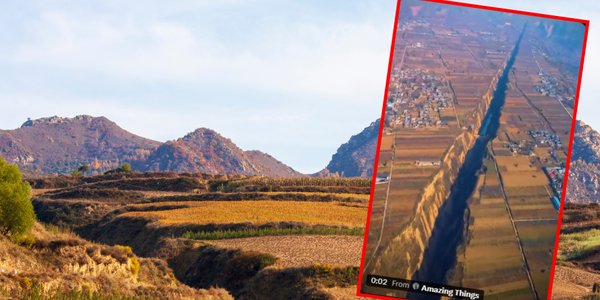
Massive 10km-long Earth fissure in China's Shanxi province widens
Translated from Polish and summarized by DistantNews. Read the original for the full story.
At a glance
News
Sources not specified
Context piece
- The Pinglu Valley in China's Shanxi province is a 10 km long and 100-meter deep fissure in the Earth's crust, formed by tectonic plate separation millions of years ago.
- Geological studies indicate the rift is part of the larger Fen-Wei fault system and is actively widening due to extensional tectonic processes.
- While visually striking and featured in films, the fissure's expansion is monitored, with recent satellite data suggesting widening rates vary but confirm ongoing geological activity.
A dramatic geological feature, the Pinglu Valley in China's Shanxi province, presents a massive fissure in the Earth's crust, stretching approximately 10 kilometers long and reaching depths of up to 100 meters. This colossal rift, a result of tectonic movements, offers a stark visual of the planet's dynamic nature.
Formed millions of years ago when the Eurasian Plate and the North China Block began to separate, the valley is classified as a rift or tectonic trench. The process, driven by convection currents in the Earth's mantle, created the initial split. Subsequent erosion by wind and water sculpted the soft loess into the steep slopes observed today.
The Pinglu Valley is not an isolated phenomenon but a segment of the extensive Fen-Wei fault system, which spans over 1200 kilometers. Scientific research confirms that this tectonic trench is continuously undergoing extension and tectonic evolution, leading to its gradual enlargement and deepening. Early geological studies from the late 1990s estimated the stretching rate between 0.5 to 1.6 millimeters per year.
More recent measurements using satellite GPS technology have provided updated, albeit varied, data on the fissure's movement. While some shorter observation periods show minimal change, regional measurements suggest widening rates of 2-4 millimeters annually. Regardless of the precise figure, the 0.5–1.6 mm per year range remains a classic geological indicator for the fissure's lengthening over millions of years.
The dramatic landscape has not gone unnoticed by filmmakers, notably featuring in the 2016 movie "The Great Wall." Its impressive scale serves as a powerful reminder of the geological forces shaping our planet.
Two lithospheric plates: the Eurasian and the North China Block said goodbye to each other and began to separate, moving in opposite directions. This is related to convection currents in the Earth's mantle. Erosion did the rest, carving steep slopes in the soft loess.
About this summary
Originally published by Rzeczpospolita in Polish. Translated, summarized, and contextualized automatically by DistantNews, with a note on how the source frames the story. Not individually reviewed before publishing. How this works.
More Stories


From Our Blog

What Gets Lost (and Found) When News Is Translated

The Critical Role of Diaspora Media in Global News

What Travellers Should Know About Countries with Restricted Press

A Digital Nomad's Guide to Following Local News

How the Same Story Looks Different in Different Countries
