


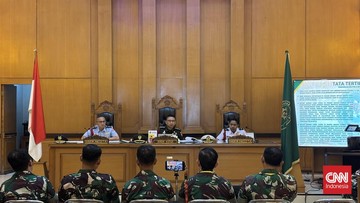
Military Court Judges Probe 'Special Operation' in Haris Azhar Assault Case
Translated from Indonesian, summarized and contextualized by DistantNews.
TLDR
- Indonesian military court judges questioned witnesses from the TNI regarding orders and special operations in the case of activist Haris Azhar.
- The defendants are accused of assaulting Haris Azhar, allegedly motivated by resentment over his activism concerning military issues.
- The court is investigating whether the assault was a "special operation" or if there was a direct order from superiors, as the defendants' roles in the military police unit do not typically involve such actions.
In a Jakarta military court, a crucial hearing unfolded concerning the alleged assault on activist Haris Azhar. The presiding judges of Military Court II-08 Jakarta intensely questioned witnesses from the Indonesian National Armed Forces (TNI) about the chain of command and the possibility of a "special operation" behind the attack. This case delves into the murky waters of military discipline, activism, and the potential for abuse of power.
What is their business with Andrie Yunus? What is their business with the TNI Law revision? What is their business with the judicial review filing of the TNI Law to the Constitutional Court? What is the correlation for them to do (the acid attack)? They are just soldiers from Denma.
The four defendants—Sergeant Major Edi Sudarko, Lieutenant One Budhi Hariyanto Widhi, Captain Nandala Dwi Prasetyo, and Lieutenant One Sami Lakka—are accused of orchestrating the acid attack. Presiding Judge Colonel Chk Fredy Ferdian Isnartanto pressed witnesses on the defendants' motives, particularly questioning their involvement in an issue seemingly unrelated to their direct duties. The judge probed whether the defendants harbored resentment towards Azhar for his vocal criticism of militarism and his involvement in challenging the TNI Law.
Permission. According to their confession to us, it was due to hurt feelings seeing Andrie Yunus's behavior when he forced his way into a closed meeting (discussion of the TNI Law at Hotel Fairmont), so the defendants felt hurt.
A key witness, Lieutenant Colonel Chk Alwi Hakim Nasution from BAIS TNI (Defense Intelligence Agency), testified that the defendants claimed their actions stemmed from "hurt feelings." They reportedly felt offended by Azhar's actions, specifically his attempt to enter a closed meeting discussing the TNI Law. However, the judge remained skeptical, pointing out the apparent lack of direct connection between the defendants and Azhar, noting that they only knew of him through media appearances. This led the judge to directly ask if there was a "command" or if this could have been a "special operation."
That's not what I mean. They have no connection with AY [Andrie Yunus]. They didn't know him initially, only saw him on TV, right? Just like us. Never knew him, only saw him on TV. How could they suddenly take such action. Did you investigate whether there was indeed an order?
The witness denied any knowledge of a direct order or a special operation, reiterating that the defendants acted out of personal offense. The judge, however, continued to explore the possibility, inquiring about which directorate within BAIS might be responsible for such operations, specifically mentioning Directorate H, which handles operations. The judge's persistent questioning highlights a deep-seated concern within the Indonesian judicial system about accountability and the potential for covert military actions against civilians. The focus on Directorate H suggests an awareness of the complex structures within the intelligence apparatus and a determination to uncover the truth, regardless of how high up the chain of command it might lead. This case is being closely watched as it touches upon sensitive issues of freedom of expression and the boundaries of military influence in Indonesian society.
Not at all, Your Honor.
DistantNews Editorial
Originally published by CNN Indonesia in Indonesian. Translated, summarized, and contextualized by our editorial team with added local perspective. Read our editorial standards.
More Stories


From Our Blog

What Gets Lost (and Found) When News Is Translated

The Critical Role of Diaspora Media in Global News

What Travellers Should Know About Countries with Restricted Press

A Digital Nomad's Guide to Following Local News

How the Same Story Looks Different in Different Countries
