

Morocco's King uses migrants as hybrid weapon against Spain, Polish analysis claims
Translated from Polish, summarized and contextualized by DistantNews.
At a glance
Analysis
Named sources
Context piece
- The article criticizes Spain's handling of a large influx of migrants into Ceuta, comparing Morocco's King Mohammed VI's strategy to that of Belarusian leader Alexander Lukashenko.
- It argues that the Moroccan king likely permitted or initiated the migration as a hybrid weapon to pressure Spain, aiming to gain concessions on territorial claims and energy cooperation.
- The author urges Poland and other EU countries to support Spain, emphasizing the need for Spanish Prime Minister Pedro Sánchez to openly address Morocco's actions to secure effective EU assistance.
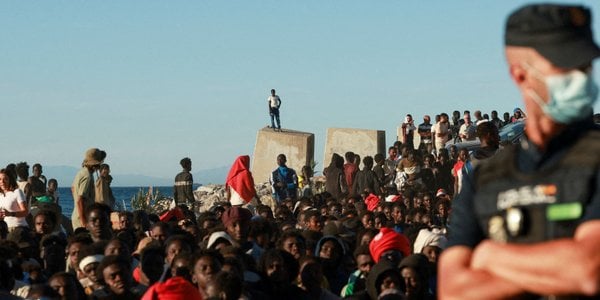
Spain's government made a strategic error by appeasing Morocco, whose King Mohammed VI employed a tactic mirroring Belarusian leader Alexander Lukashenko's use of migrants as a hybrid weapon. This is the assertion of Jędrzej Bielecki in Rzeczpospolita, who argues that the recent influx of approximately 60,000 migrants into the Spanish enclave of Ceuta was either initiated or permitted by the Moroccan king.
Invasion of Ceuta was carried out on the initiative or with the permission of Morocco
Bielecki draws a parallel between King Mohammed VI's actions and those of Lukashenko, who used migrants to pressure Poland and the EU border. He notes that Brussels even agreed to co-finance the "Eastern Shield" defense system for Poland's border. The Moroccan king, according to the analysis, holds a powerful card: the potential to unleash a wave of migrants towards the Canary Islands, a far greater problem for Spain than the situation in Ceuta. Madrid has long sought to placate its southern neighbor.
The author contends that it is clear to anyone familiar with Moroccan realities that the invasion of Ceuta was orchestrated with the king's approval. He points out that while Spanish Prime Minister Pedro Sánchez spoke of a "violation of Spain's territorial integrity," the Moroccan ambassador in Madrid was not even summoned for consultations. This, Bielecki argues, emboldens the Moroccan regime to escalate its conflict, with aims including the annexation of Ceuta and Melilla, recognition of Moroccan rule over Western Sahara, and forcing Spain to sever energy cooperation with Algeria, Morocco's rival.
King Mohammed VI has adopted a strategy similar to Lukashenko's.
Bielecki believes King Mohammed VI is winning this confrontation with Sánchez. He criticizes European public opinion for being swayed into believing the crisis stems from Spain's legalization of migrant residency and insufficient border control, despite no Moroccan migrants having entered the Iberian Peninsula from Ceuta or being included in the legalization program. The author concludes by urging Poland and other EU nations to stand in solidarity with Spain, framing it as a bastion of democracy in southwestern Europe, akin to Poland's role in northeastern Europe. However, he stresses that for the EU to effectively help Spain, Prime Minister Sánchez must speak truthfully about the "grim Moroccan reality."
Spain constitutes a bastion of democracy and freedom in southwestern Europe, just as our country does in northeastern Europe.
DistantNews Editorial
Originally published by Rzeczpospolita in Polish. Translated, summarized, and contextualized by our editorial team with added local perspective. Read our editorial standards.
More Stories


From Our Blog

What Gets Lost (and Found) When News Is Translated

The Critical Role of Diaspora Media in Global News

What Travellers Should Know About Countries with Restricted Press

A Digital Nomad's Guide to Following Local News

How the Same Story Looks Different in Different Countries
