


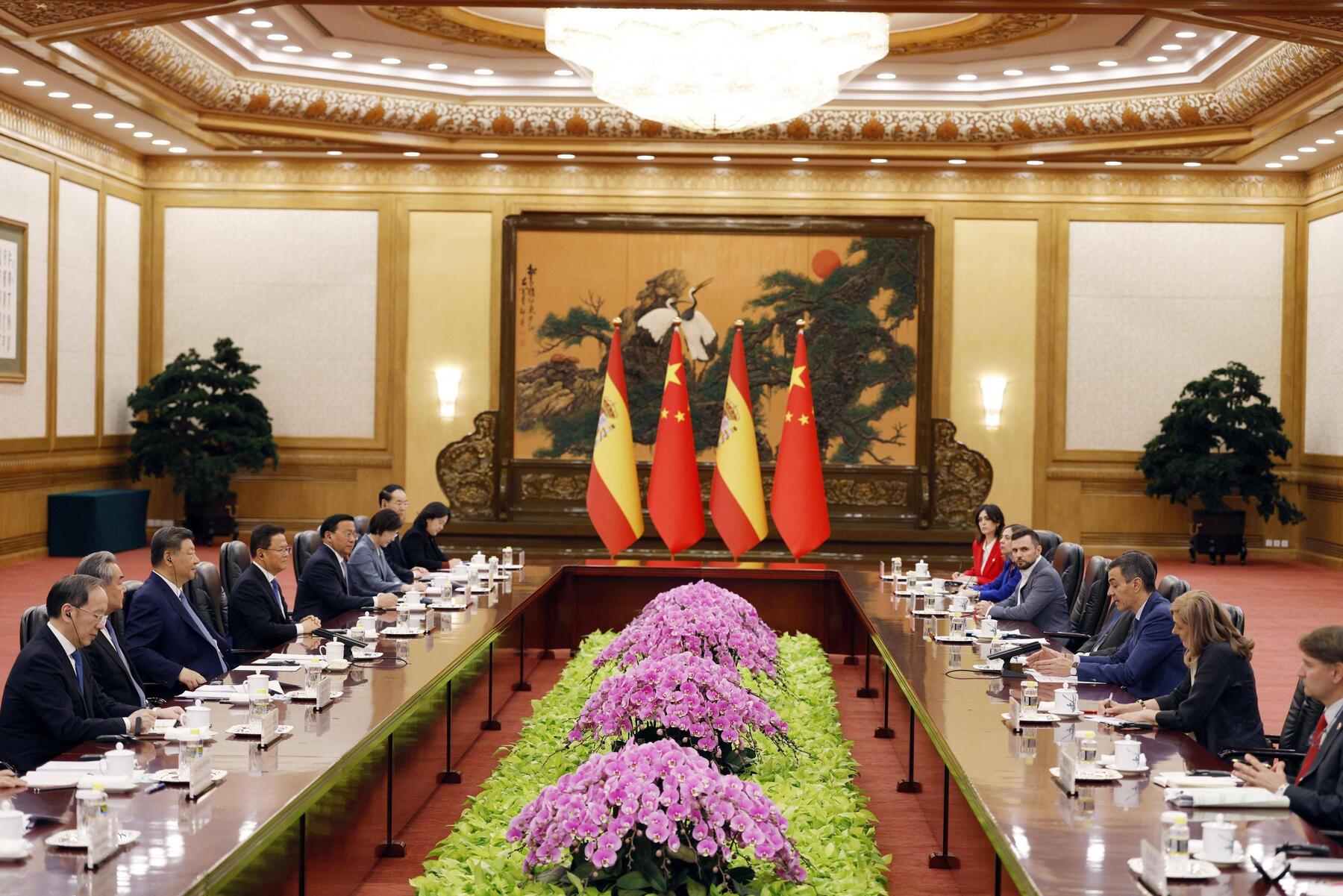
Pedro Sánchez Offers Himself to Xi Jinping, Thereby Scoring a Strategic Own Goal
Translated from German, summarized and contextualized by DistantNews.
TLDR
- Spanish Prime Minister Pedro Sánchez met with Chinese President Xi Jinping in Beijing, aligning Spain with China's vision of a multipolar world order.
- Sánchez criticized U.S. Middle East policy, positioning China as an alternative partner to Washington.
- Critics argue Sánchez's "pragmatism" could harm Spain and the EU by endorsing an authoritarian regime's worldview.
Die Presse reports on Spanish Prime Minister Pedro Sánchez's recent visit to Beijing, where he met with Chinese President Xi Jinping. The article frames Sánchez's engagement as a strategic misstep, a "strategic own goal," that aligns Spain with China's vision of a new world order. By positioning himself as a proponent of a multipolar world built on "respect and pragmatism," Sánchez appears to be actively endorsing Xi Jinping's challenge to the U.S.-led global system. This move, driven by what the article terms "self-interest," risks alienating traditional allies and undermining both Spanish and European interests.
Sánchez's criticism of U.S. policy in the Middle East, particularly concerning the Iran conflict, and his embrace of Xi's narrative—which decries global "chaos" and the "law of the jungle" attributed to the U.S.—places Spain in a precarious diplomatic position. The article highlights that China, under Xi, seeks to subtly reshape the UN-based system rather than dismantle it, aiming to secure the Chinese Communist Party's leadership. Spain's support for Xi's four development initiatives, following Hungary and Slovakia, is seen as a significant endorsement of an authoritarian model that reinterprets concepts like democracy and human rights through a distinctly non-Western lens.
In today's world, chaos is rampant everywhere, the law of the jungle prevails.
From our perspective at Die Presse, this development is deeply concerning. While Sánchez may believe he is acting pragmatically, he seems to overlook or dismiss the fundamental differences between liberal democratic values and the worldview of an authoritarian regime like China's. The article implicitly questions Sánchez's judgment, suggesting he is either unaware of or willing to ignore the potential long-term damage his "pragmatism" could inflict on Spain and the European Union. The narrative presented is one of a European leader seemingly captivated by an alternative global vision, potentially at the expense of established alliances and democratic principles. This story is uniquely interesting from a European perspective as it highlights internal divisions and differing approaches to engaging with a rising global power like China, contrasting sharply with a more unified, albeit sometimes critical, stance often seen in U.S. foreign policy discourse.
The goal is the creation of a multipolar world order, built on respect and pragmatism.
DistantNews Editorial
Originally published by Die Presse in German. Translated, summarized, and contextualized by our editorial team with added local perspective. Read our editorial standards.
More Stories



From Our Blog

What Gets Lost (and Found) When News Is Translated

The Critical Role of Diaspora Media in Global News

What Travellers Should Know About Countries with Restricted Press

A Digital Nomad's Guide to Following Local News

How the Same Story Looks Different in Different Countries
