

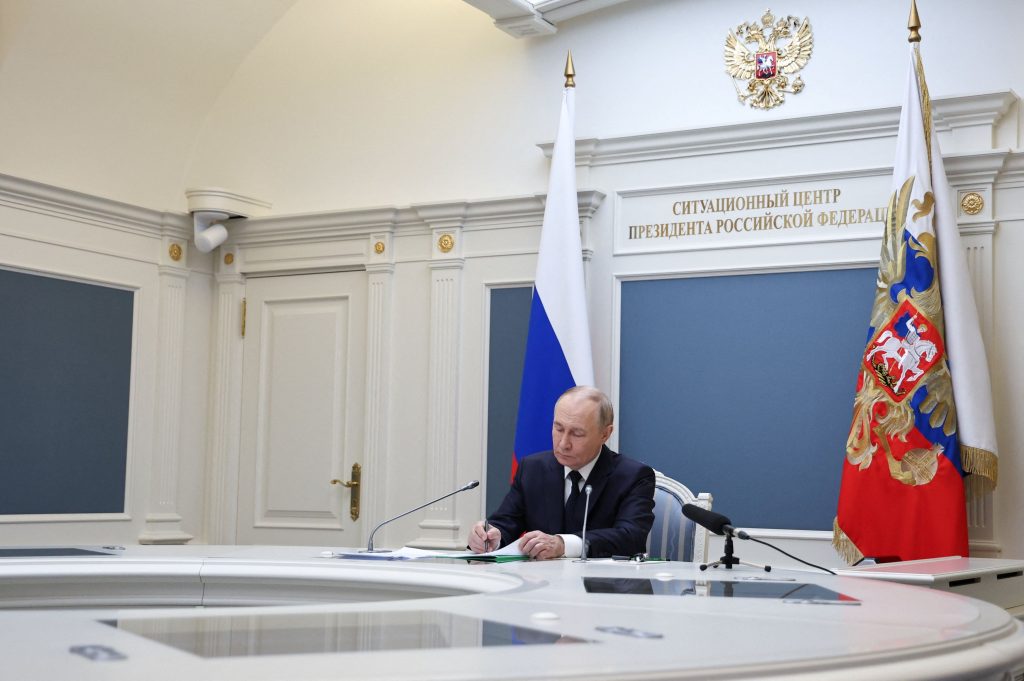
Putin says the conflict in Ukraine is coming to an end
Translated from Greek, summarized and contextualized by DistantNews.
TLDR
- Russian President Vladimir Putin stated that the conflict in Ukraine is nearing its end.
- Putin expressed openness to talks but preferred former German Chancellor Gerhard Schröder as a mediator.
- He also commented on potential conflicts involving Iran and Armenia's aspirations for EU membership.
President Vladimir Putin has declared that the conflict in Ukraine is approaching its conclusion, a statement that carries significant weight given Russia's ongoing military operations. Speaking to journalists, Putin conveyed a sense of optimism about the trajectory of the situation, suggesting that a resolution is within reach. This assertion, while potentially aimed at shaping international perceptions, comes at a time when European Union leaders are reportedly preparing for potential discussions regarding the conflict.
Πιστεύω ότι το ζήτημα φθάνει στο τέλος», ανέφερε ο Πούτιν σε δηλώσεις του προς δημοσιογράφους, αναφερόμενος στον πόλεμο στην Ουκρανία.
When questioned about his willingness to engage in dialogue, Putin indicated a preference for former German Chancellor Gerhard Schröder as a potential interlocutor. This preference highlights a complex dynamic in Russia's relationship with Europe, where direct engagement with current leadership has been strained. The Kremlin has previously stated that any initiative for rapprochement should originate from European nations, who severed ties with Moscow in 2022 following the invasion of Ukraine. Putin's stance suggests a desire for a mediator who might bridge the gap, possibly reflecting a belief that certain figures from the past hold more sway or are less compromised in the eyes of Moscow.
Ερωτηθείς αν θα ήταν διατεθειμένος να συμμετάσχει σε τέτοιες επαφές, ο ρώσος πρόεδρος απάντησε ότι προτιμά ως συνομιλητή τον πρώην καγκελάριο της Γερμανίας, Γκέρχαρντ Σρέντερ.
Putin also touched upon other international issues, expressing hope for a swift resolution to the conflict involving Iran, warning that all parties would suffer if it persisted. Furthermore, he commented on Armenia's potential aspirations for European Union membership. Putin suggested that it would be "logical" for Armenia to hold a referendum on joining the EU, given its historical ties with Moscow and its recent hosting of a European summit. This statement implies that Russia expects Armenia, a traditional ally, to consult its citizens before making such a significant geopolitical shift, and that Russia would then formulate its own response based on the Armenian people's decision.
Ο Πούτιν πρόσθεσε ότι θα συναντηθεί με τον ουκρανό πρόεδρο Βολοντίμιρ Ζελένσκι μόνο όταν υπάρξει μια βιώσιμη ειρηνευτική συμφωνία μεταξύ των δύο πλευρών.
From a Russian perspective, as reported by Ta Nea, Putin's statements are presented as a confident assessment of the geopolitical landscape. The framing emphasizes Russia's strategic patience and its willingness to engage in dialogue under specific conditions, while also projecting an image of control over the unfolding events. The mention of Schröder as a preferred mediator, and the conditional approach to Ukraine, Armenia, and Iran, suggests a calculated foreign policy aimed at navigating complex international relations while asserting Russian interests. The narrative does not dwell on the human cost of the conflict in Ukraine but rather on the strategic and diplomatic maneuvering, reflecting a national perspective that prioritizes state interests and stability as defined by Moscow.
Η ουκρανική πλευρά θα πρέπει να απαντήσει στην πρόταση που έγινε από τον πρόεδρο των Ηνωμένων Πολιτειών. Δυστυχώς μέχρι σήμερα δεν έχουμε λάβει καμιά πρόταση», σημείωσε ο Πούτιν.
DistantNews Editorial
Originally published by Ta Nea in Greek. Translated, summarized, and contextualized by our editorial team with added local perspective. Read our editorial standards.
More Stories
From Our Blog

What Gets Lost (and Found) When News Is Translated

The Critical Role of Diaspora Media in Global News

What Travellers Should Know About Countries with Restricted Press

A Digital Nomad's Guide to Following Local News

How the Same Story Looks Different in Different Countries
