


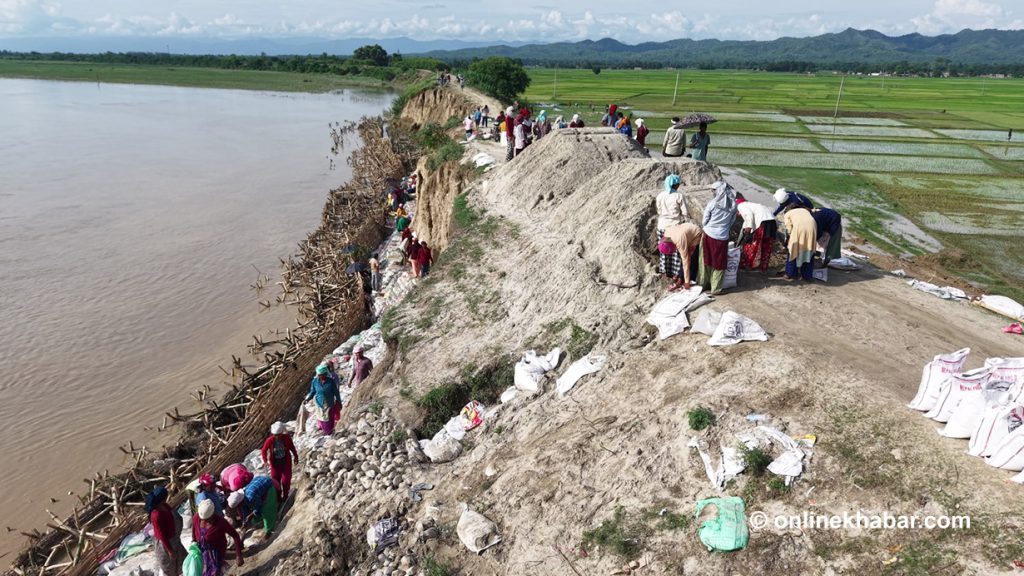
Rapti River Claims Ancestral Land in Banke, Nepal
Translated from English, summarized and contextualized by DistantNews.
TLDR
- An 81-year-old man in Banke, Nepal, is losing his ancestral land as the Rapti River shifts its course southward.
- The river has eroded his property over decades, reducing his original 10 bighas of land to about four to five bighas, destroying orchards and fields.
- Despite owning the land and paying taxes, the river now flows over his property, forcing him to relocate his house multiple times.
This report from OnlineKhabar highlights the devastating impact of river erosion on a family in Banke, Nepal, where the Rapti River's natural course change is literally swallowing ancestral land. The story of 81-year-old Amrikan Prasad Dubey, who once owned 10 bighas and has seen his land shrink to a fraction due to the river's southward shift, is a poignant example of the environmental challenges faced by communities in the region.
Now, only about four to five bighas remain. The fruit orchard and paddy fields have all been cut away.
Dubey's narrative is one of loss and resilience. He recounts how his fruit orchards and paddy fields have been claimed by the river, forcing him to move his home repeatedly. The emotional attachment to his ancestral land, where his father chose to settle, is palpable as he speaks of continuing to pay taxes on land that is no longer usable. The construction of a concrete embankment after the devastating 2014 floods offered temporary relief, but nature's power proved relentless, with the embankment itself being destroyed in subsequent floods.
I have the land ownership certificate, and I still pay taxes, but the river is flowing over my land.
From a Nepalese perspective, this is not just an individual tragedy but a reflection of a broader environmental issue affecting many communities along Nepal's rivers. The story underscores the vulnerability of rural populations to climate change and natural disasters. The repeated suffering during monsoons, despite appeals to authorities for rebuilding embankments, points to the challenges in implementing effective, long-term solutions. The article implicitly critiques the inadequacy of current disaster management and infrastructure efforts in the face of such persistent environmental threats.
I don’t feel like leaving the place my father chose.
The article serves as a stark reminder of how natural forces can displace people and disrupt lives, even when they hold legal title to their land. It calls attention to the need for more sustainable and robust measures to protect communities from river erosion and flooding, issues that are critical for the well-being and stability of rural Nepal.
After the flood entered the village, only water could be seen everywhere. It looked like an ocean, and we had to use boats to rescue people to safer places.
DistantNews Editorial
Originally published by OnlineKhabar English in English. Translated, summarized, and contextualized by our editorial team with added local perspective. Read our editorial standards.
More Stories


From Our Blog

What Gets Lost (and Found) When News Is Translated

The Critical Role of Diaspora Media in Global News

What Travellers Should Know About Countries with Restricted Press

A Digital Nomad's Guide to Following Local News

How the Same Story Looks Different in Different Countries
