

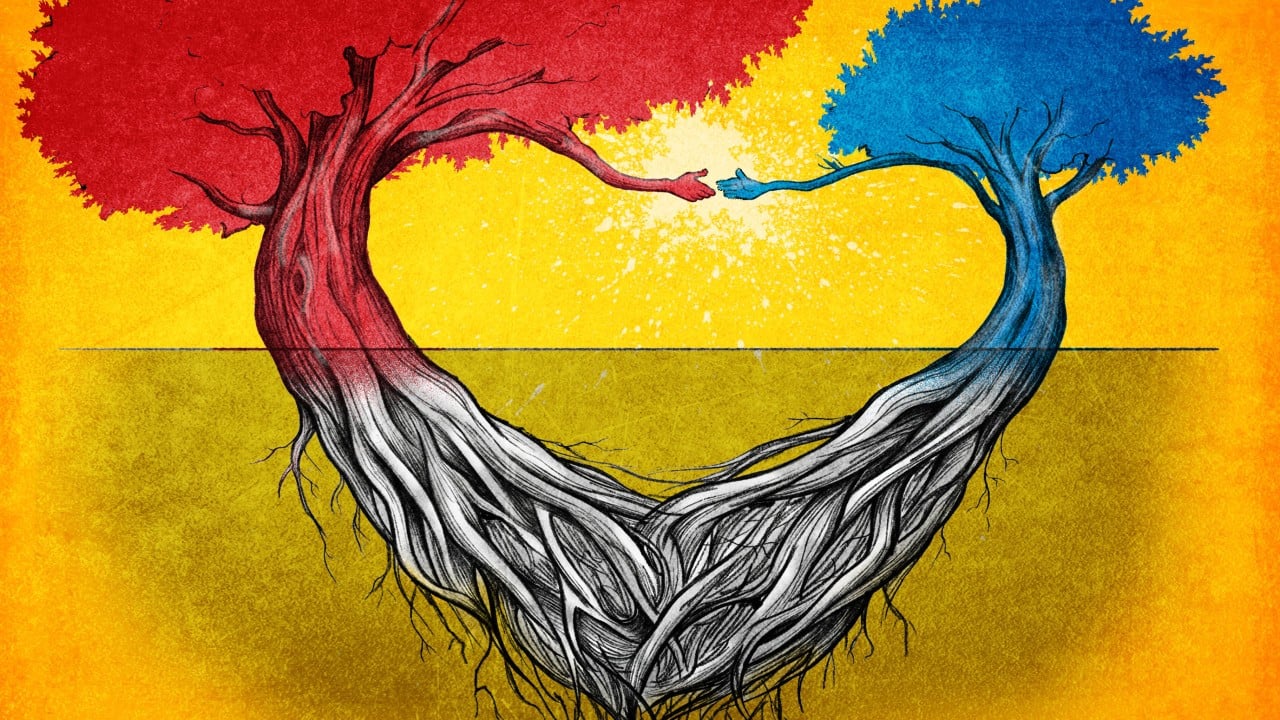

Rise of China Complicates 'Authoritarian' vs 'Democratic' Binary
Translated from English, summarized and contextualized by DistantNews.
TLDR
- The clarity of political labels like 'free,' 'democratic,' 'liberal,' and 'authoritarian' is increasingly blurred and contested.
- This linguistic ambiguity reflects a deeper mismatch between the language used and the realities of political systems.
- The post-Cold War era often assumed liberal democracy was the ideal model, with authoritarianism seen as its inefficient opposite.
The South China Morning Post observes a growing unease in how political systems are described, noting that terms once considered clear, such as 'free,' 'democratic,' 'liberal,' and 'authoritarian,' have become increasingly blurred and contested. This is not merely a semantic issue but reflects a significant disconnect between the language we employ and the complex realities of global politics. For decades, the framework of 'liberal democracy' served as both a descriptive and normative standard, implying a universal path for political and economic development. Within this paradigm, 'authoritarianism' was largely characterized as its rigid, repressive, and ultimately inefficient counterpart, presumed to struggle with innovation in a rapidly evolving global economy due to its restrictions on information and dissent.
Words that once seemed clear no longer illuminate as they should.
However, the rise of China and other nations presents a significant challenge to this binary. The article implicitly questions whether this simplistic dichotomy accurately captures the nuances of contemporary governance and development models. The traditional assumption that liberal democracy inherently leads to economic prosperity and social well-being is being tested by alternative models that demonstrate significant economic growth and societal stability, albeit under different political structures. This complicates the narrative that has dominated international discourse since the end of the Cold War, forcing a re-evaluation of how we categorize and understand political systems worldwide.
This is not simply a matter of semantics. It reflects a deeper mismatch between the language we use and the realities we are trying to describe.
From a regional perspective, particularly in Asia, the narrative is often more complex than a simple 'democratic' versus 'authoritarian' divide. Many countries in the region navigate a path that incorporates elements of both, or prioritize stability and economic development under systems that may not fit Western democratic ideals. The article's focus on the 'authoritarian' label as a tool of disapproval, rather than analysis, resonates with concerns that Western media often imposes its own political values. The South China Morning Post, based in Hong Kong, is positioned to observe these shifts firsthand, understanding that the global political landscape is far more varied and less easily categorized than the binary suggests. The challenge lies in developing a more precise and less ideologically charged vocabulary to describe the diverse political realities of the 21st century.
While today’s discourse is far more open, that concern is increasingly loud in the way political labels are deployed – less as analytical tools and more as signals of approval or disapproval.
DistantNews Editorial
Originally published by South China Morning Post in English. Translated, summarized, and contextualized by our editorial team with added local perspective. Read our editorial standards.
More Stories


From Our Blog

Countries Without a Free Press: What You Need to Know

What Press Freedom Means for the News You Read

What Gets Lost (and Found) When News Is Translated

The Critical Role of Diaspora Media in Global News

What Travellers Should Know About Countries with Restricted Press
