


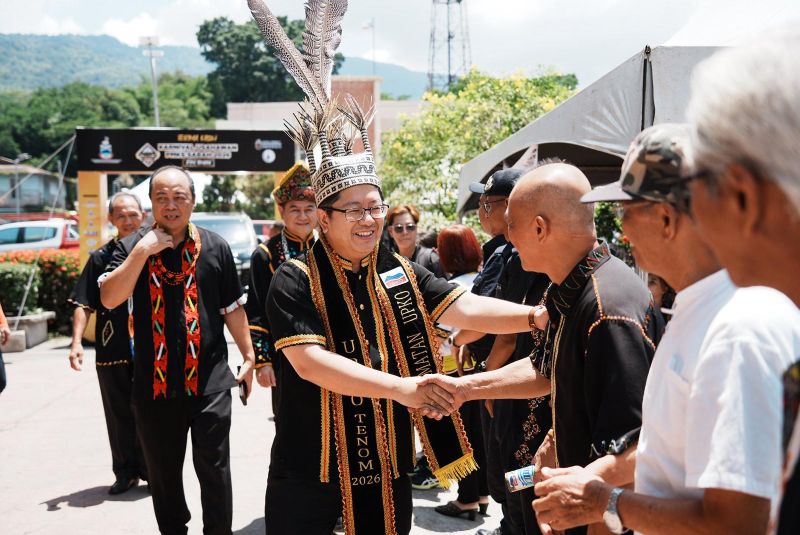
Sabah's rights must be fought for collectively, regardless of political party: UPKO
Translated from Malay, summarized and contextualized by DistantNews.
TLDR
- UPKO President Datuk Ewon Benedick stated that Sabah's rights, including the 40% state revenue claim, must be pursued collectively by all political parties.
- He emphasized that Sabah's rights belong to all its people and called for unity in their pursuit through various platforms, including government and public movements.
- Benedick acknowledged the efforts of the Sabah and Federal governments in restoring Sabah's rights, referencing the Malaysia Agreement 1963 (MA63) and upcoming environmental legislation.
The United Progressive Kinabalu Organisation (UPKO) is steadfast in its commitment to championing Sabah's rights, a principle enshrined in its party constitution since its inception. President Datuk Ewon Benedick's call for a unified front, irrespective of political affiliation, to pursue these rights—particularly the long-standing claim for 40% of state revenue—resonates deeply within Sabah. This is not merely a political talking point; it is a matter of constitutional entitlement and economic self-determination as outlined in the Malaysia Agreement 1963 (MA63).
This includes through the Cabinet, Dewan Rakyat, Dewan Negara, Dewan Undangan Negeri (DUN) as well as people's movements such as workshops, forums and awareness rallies.
UPKO's stance, as articulated by Benedick, is that Sabah's rights are indivisible and belong to every citizen of the state. This inclusive approach is crucial, as it aims to mobilize broad support for a cause that affects the collective well-being of Sabahans. The party advocates for leveraging all available channels, from parliamentary debates to grassroots awareness campaigns, ensuring that the pursuit of these rights is both comprehensive and persistent. This multi-pronged strategy reflects a pragmatic understanding of the political landscape and the need for sustained advocacy.
I want to emphasize that Sabah's rights are the rights of all the people of this state, not the property of a select few. Therefore, all leaders and people of Sabah must unite in fighting for them.
While acknowledging the progress made, particularly the restoration of 13 points concerning Sabah's rights, UPKO remains vigilant. Benedick pointed to the upcoming environmental and solid waste management bill as a positive step, but also highlighted ongoing disputes, such as the Federal Government's reluctance to share petroleum revenue data. This illustrates the complex and often challenging negotiations involved in reclaiming and asserting state autonomy within the Malaysian federal structure.
One of these goals is to demand the implementation of Sabah's rights as enshrined in the Federal Constitution and agreed upon in the Malaysia Agreement 1963 (MA63).
From a Sabahan perspective, the fight for rights under MA63 is a defining narrative. It speaks to a historical sense of distinctiveness and a desire for greater control over resources and governance. While national media might frame this as a state-federal issue, for Sabahans, it is fundamentally about ensuring that the state receives its due and that its unique position within Malaysia is fully recognized and respected. UPKO's consistent advocacy, as reported by Utusan Malaysia, plays a significant role in keeping these critical issues at the forefront of public discourse.
We record our appreciation to the Sabah Government leadership under Chief Minister Datuk Seri Hajiji Noor and the Federal Government for their efforts in restoring Sabah's rights through the implementation of 13 points so far.
DistantNews Editorial
Originally published by Utusan Malaysia in Malay. Translated, summarized, and contextualized by our editorial team with added local perspective. Read our editorial standards.
More Stories

From Our Blog

What Gets Lost (and Found) When News Is Translated

The Critical Role of Diaspora Media in Global News

What Travellers Should Know About Countries with Restricted Press

A Digital Nomad's Guide to Following Local News

How the Same Story Looks Different in Different Countries
