


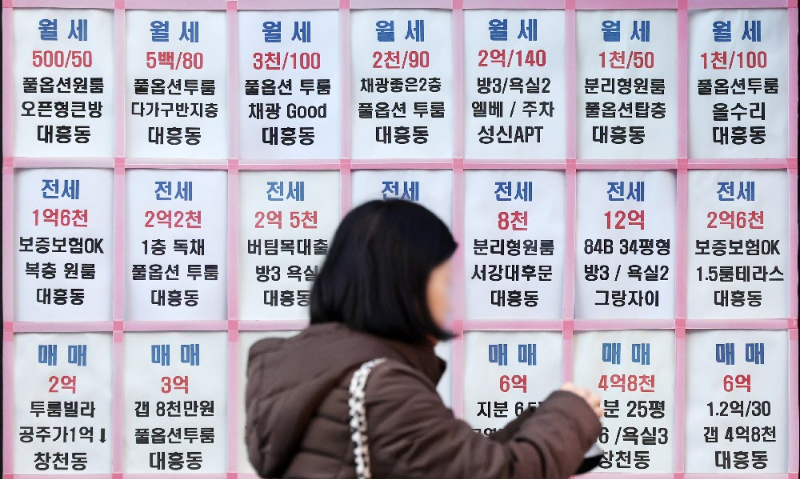
Seoul Apartment Rentals: Monthly Rent Surpasses 50% for First Time, Raising Affordability Concerns
Translated from Korean, summarized and contextualized by DistantNews.
TLDR
- The proportion of monthly rent in apartment rental contracts in Seoul exceeded 50% for the first time in the first quarter of this year, reaching its highest point since statistics began in 2014.
- This surge in monthly rent is attributed to a shortage of jeonse (lump-sum deposit) properties, influenced by government regulations like land and housing transaction permits and strengthened residency requirements.
- The shift to higher monthly rents increases housing costs for young people and low-income households, potentially impacting consumption and hindering wealth accumulation, prompting calls for deregulation of multi-family housing to ease the burden.
The recent surge in monthly rent contracts for apartments in Seoul, surpassing 50% for the first time in the first quarter of this year, signals a worrying trend for the housing market. This phenomenon, unprecedented since statistics were first compiled in 2014, highlights a critical imbalance where the traditional Korean 'jeonse' system is increasingly out of reach for many.
The proportion of monthly rent in apartment rental contracts in Seoul exceeded 50% for the first time in the first quarter of this year, reaching its highest point since statistics began in 2014.
The primary driver behind this shift is the severe scarcity of jeonse properties. Government policies, such as designating large areas as permit zones for land transactions and tightening residency requirements, have inadvertently reduced the supply of jeonse homes. Furthermore, tax policies aimed at discouraging multiple homeownership have also contributed to a decrease in jeonse listings, despite potentially increasing the number of homes available for sale.
The shift to higher monthly rents increases housing costs for young people and low-income households, potentially impacting consumption and hindering wealth accumulation.
This escalating reliance on monthly rent places a significant burden on young individuals and lower-income families. With jeonse becoming a distant dream, the ability to save and eventually purchase a home, a cornerstone of generational wealth accumulation, is severely hampered. The increased housing expenditure can lead to reduced disposable income, impacting overall consumption and economic vitality. The situation is exacerbated by rising monthly rent prices themselves, as demand increasingly funnels into this segment of the market.
The government has pledged to increase public housing supply, but it is clear that this alone will not suffice.
While the government has pledged to increase public housing supply, it is clear that this alone will not suffice. Dong-A Ilbo urges a more immediate and decisive approach: the deregulation of multi-family housing options like townhouses and studio apartments. By easing restrictions on these types of properties, the government can facilitate a quicker increase in supply and provide much-needed relief to citizens struggling with escalating housing costs. The current trajectory is unsustainable and demands proactive measures to ensure housing affordability and economic stability for all.
Dong-A Ilbo urges a more immediate and decisive approach: the deregulation of multi-family housing options like townhouses and studio apartments.
DistantNews Editorial
Originally published by Dong-A Ilbo in Korean. Translated, summarized, and contextualized by our editorial team with added local perspective. Read our editorial standards.
More Stories


From Our Blog

What Gets Lost (and Found) When News Is Translated

The Critical Role of Diaspora Media in Global News

What Travellers Should Know About Countries with Restricted Press

A Digital Nomad's Guide to Following Local News

How the Same Story Looks Different in Different Countries
