


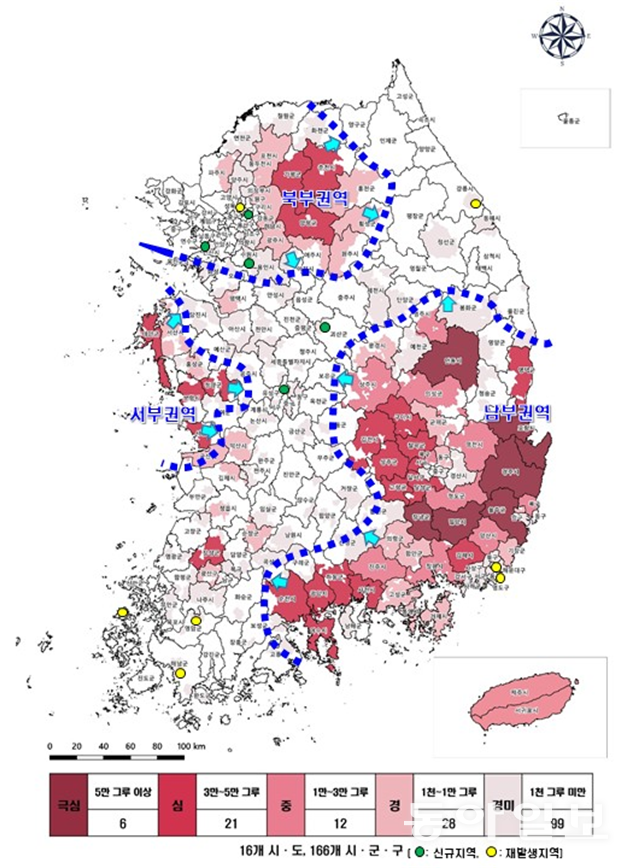
South Korea builds 400km defense belt against pine wilt disease
Translated from Korean, summarized and contextualized by DistantNews.
At a glance
News
Sources not specified
Ongoing story
- South Korea is establishing a 400km national defense belt to combat pine wilt disease, which is accelerating due to climate change and lacks a cure.
- The disease, spread by pine and black turpentine beetles, has caused millions of dead trees annually, with projections showing an increase.
- The strategy includes AI and advanced sensors for early detection, eco-friendly pest control, and a 4km-wide buffer zone along infected areas.
South Korea is constructing a 400-kilometer national defense belt to combat the spread of pine wilt disease, a devastating ailment that kills pine trees within a year and has no cure. The disease's proliferation is being accelerated by climate change, raising concerns about future outbreaks.
The pine wilt nematode, transmitted by pine and black turpentine beetles, infects pine, Japanese red pine, and Korean pine trees. It obstructs the trees' water and nutrient transport systems, leading to rapid death. The disease has caused significant damage, with over 1.77 million dead trees recorded in 2026 alone, a figure that has steadily increased in recent years. Climate change is a major factor, as warmer temperatures allow the beetles to mature earlier and extend their active periods, increasing the risk of infection.
To counter this threat, the Korea Forest Service is implementing a multi-pronged strategy. This includes establishing a 4km-wide buffer zone along infected areas, dubbed the "national defense belt," where intensive control measures like thinning and species conversion will be applied. This belt aims to contain the spread, similar to a demilitarized zone, by gradually concentrating infections within a defined area and disrupting beetle migration.
Advanced technologies are also being deployed. An aerial monitoring system using multi-spectral sensors on helicopters, combined with AI analysis, will help detect infected trees early by identifying subtle differences in light reflection. Furthermore, research is underway with the U.S. Department of Agriculture to develop eco-friendly control methods that inhibit beetle reproduction and reduce their flight capabilities, targeting the disease's vectors directly.
DistantNews Editorial
Originally published by Dong-A Ilbo in Korean. Translated, summarized, and contextualized by our editorial team with added local perspective. Read our editorial standards.
More Stories



From Our Blog

What Gets Lost (and Found) When News Is Translated

The Critical Role of Diaspora Media in Global News

What Travellers Should Know About Countries with Restricted Press

A Digital Nomad's Guide to Following Local News

How the Same Story Looks Different in Different Countries
