


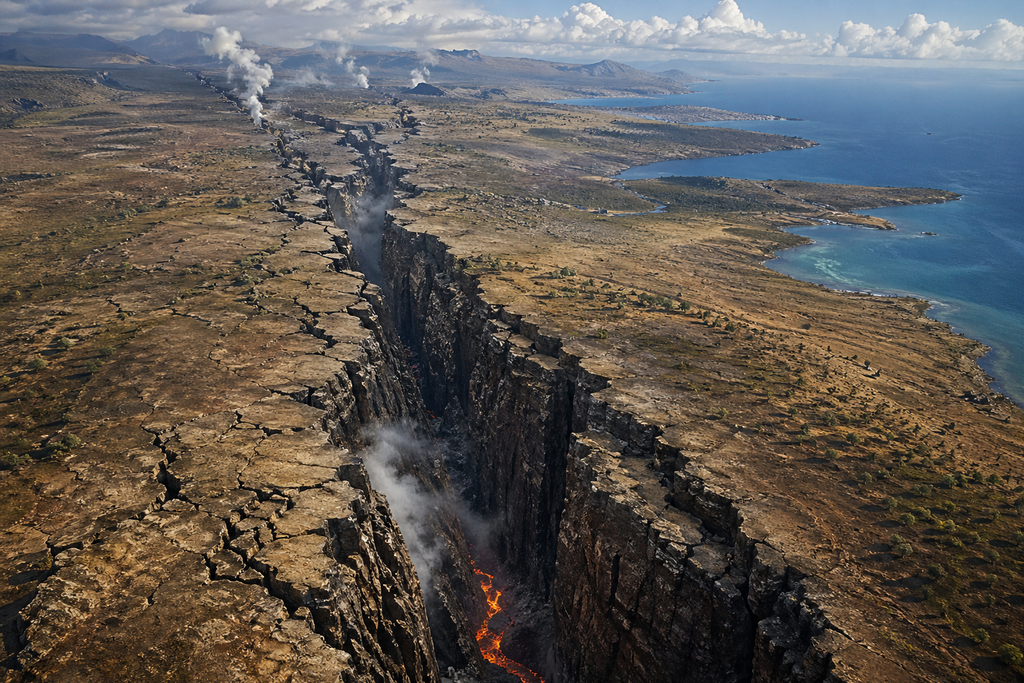
Tectonic upheaval in Africa: The phenomenon creating a new ocean and changing the Earth
Translated from Greek, summarized and contextualized by DistantNews.
TLDR
- A significant geological shift is occurring in Africa, centered around the East African Rift, which scientists believe will lead to the formation of a new ocean basin.
- This process involves the divergence of three tectonic plates: the Arabian, Nubian, and Somali, gradually splitting the continent.
- The geological transformation is expected to take millions of years but will fundamentally reshape the geography and climate of East Africa, potentially separating Somalia and parts of Ethiopia, Kenya, and Tanzania from the rest of the continent.
A monumental geological event is unfolding in Africa, capturing the attention and awe of the scientific community. Recent geological reports indicate that the continent is on the cusp of a dramatic division, a process that promises to birth an entirely new ocean basin. This cataclysmic yet fascinating transformation is centered on the East African Rift, a colossal fissure stretching approximately 3,000 kilometers from the Afar Triangle in Ethiopia to Mozambique.
This rift is a unique natural laboratory where scientists can observe firsthand the transition of a continental rift into an oceanic one. The driving force behind this phenomenon is the gradual separation of three major tectonic plates: the Arabian, Nubian, and Somali. Evidence of this slow but relentless geological power was dramatically displayed in 2005 when a crack over 60 kilometers long suddenly appeared in the Ethiopian desert following a volcanic eruption. While the complete formation of the new ocean is projected to take five to ten million years, geologists warn of radical consequences.
The ultimate outcome will be the physical separation of Somalia and significant portions of Ethiopia, Kenya, and Tanzania from the main Nubian plate. This will result in the "Horn of Africa" as we know it being dramatically altered, with this landmass drifting into the Indian Ocean. Beyond the sheer geographical reconfiguration, the climatic implications are predicted to be profound. The emergence of a sea channel will alter ocean currents, impacting regional temperatures and rainfall patterns. Areas currently arid may gain coastlines and increased humidity, while the ongoing tectonic activity could also lead to the formation of new mountain ranges, permanently changing the ecosystem of the eastern part of the continent.
DistantNews Editorial
Originally published by Ta Nea in Greek. Translated, summarized, and contextualized by our editorial team with added local perspective. Read our editorial standards.
More Stories

From Our Blog

What Gets Lost (and Found) When News Is Translated

The Critical Role of Diaspora Media in Global News

What Travellers Should Know About Countries with Restricted Press

A Digital Nomad's Guide to Following Local News

How the Same Story Looks Different in Different Countries
