


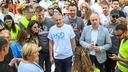
Thompson Performs at Zagreb's 'Walk for Life' Amidst Controversy, Mayor Criticizes Organizers
Translated from Croatian, summarized and contextualized by DistantNews.
TLDR
- Marko Perković Thompson performed at the "Walk for Life" event in Zagreb, despite being banned from performing on city-managed venues.
- Zagreb Mayor Tomislav Tomašević criticized the organizers for falsifying the performer list to include Thompson.
- The "Walk for Life" event advocates for laws protecting life from conception, while the "Trnjanski Kresovi" event commemorates the anniversary of partisan troops entering Zagreb in 1945.
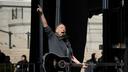
Zagreb found itself at the center of a cultural and political storm this past weekend, as the "Walk for Life" event, advocating for stricter abortion laws, featured a surprise performance by controversial singer Marko Perković Thompson. This occurred despite a city council decision to ban Thompson from performing in venues managed by the City of Zagreb. The singer's rendition of "Lijepa li si" on Zrinjevac was a direct challenge to the city authorities, who had explicitly requested that Thompson not be included in the list of performers for the event.
When it comes to public spaces, I must admit that it is quite unbelievable to me that the organizers of the Walk for Life went so far as to falsify the list of performers at Zrinjevac, just so Thompson could sing one song.
Mayor Tomislav Tomašević expressed his strong disapproval, not of the song itself, but of the organizers' alleged deception. "It is quite unbelievable to me that the organizers of the Walk for Life went so far as to falsify the list of performers at Zrinjevac, just so Thompson could sing one song," Tomašević stated. He reiterated that Thompson would continue to be barred from performing in city-owned spaces, emphasizing that his issue lies with the manipulation of the process, not the content of the song.
This incident highlights the deep ideological divisions within Croatia. The "Walk for Life" movement, represented by organizations like "U ime obitelji" (In the Name of the Family), argues for a legal framework that recognizes life from conception, citing scientific evidence and advocating for taxpayer support for families. They criticize current abortion laws as outdated, stemming from a "communist era." Conversely, the city's commemoration of the anniversary of partisan troops entering Zagreb in 1945, known as "Trnjanski Kresovi," represents a different historical narrative, one that celebrates liberation from fascism.
We want families, women, and children to be supported with taxpayer money, that the law protects the life of every human being, and that Croatia enters into a social dialogue and gets a law based on science, and science says that life begins at conception and that the child a woman carries is a human being.
From a Croatian perspective, this event is not just about a singer or a protest; it's a microcosm of the ongoing societal debate about values, history, and national identity. While international media might focus on the "ban" and the political spat, for many in Croatia, it's about deeply held beliefs regarding life, family, and the interpretation of historical events. The fact that Thompson, a figure who evokes strong nationalistic sentiments for some and controversy for others, performed at an event advocating for the "protection of life" is a potent symbol in this ongoing cultural dialogue. The city's administration, led by Tomašević, is navigating these complex issues, attempting to balance public order, historical commemoration, and a progressive political agenda against deeply entrenched social movements.
I insist that in Croatia today, a 'communist law from 1978' is in effect, when an ultrasound required a room to fit the machine, although much has been learned in the meantime about prenatal development that supports the thesis that it is a unique and irreplaceable person who feels pain during an abortion.
DistantNews Editorial
Originally published by Večernji List in Croatian. Translated, summarized, and contextualized by our editorial team with added local perspective. Read our editorial standards.
More Stories


From Our Blog

What Gets Lost (and Found) When News Is Translated

The Critical Role of Diaspora Media in Global News

What Travellers Should Know About Countries with Restricted Press

A Digital Nomad's Guide to Following Local News

How the Same Story Looks Different in Different Countries
